

KANSAS CITY, Mo. — KSHB 41 reporter Isabella Ledonne reports on stories in Overland Park, Johnson County and topics about government accountability. Multiple viewers have reached out to Isabella for or against the effects of kratom and 7-OH. She continues to provide updates on regulation attempts, the effects of the products and their impact in the metro. Share your story idea with Isabella.
—
Advocates and city leaders are speaking out about kratom and its synthetic derivative, 7-OH.
Mayor Quinton Lucas proposed a blanket ban in Kansas City, Missouri, on selling the unregulated products within city limits.
Addiction prevention specialists expressed their support for the proposed ban.

"[7-OH] is drawing people in just like heroin does, just like meth does," said Joey Thomas, recovery housing at Healing House KC.
If the proposed ban goes into effect, business owners could face daily fines up to $1,000, a suspended business license and even six months of jail time.

"[If the ordinance passes], if you have these products at your store, you're violating the ordinance," said Lace Cline, director of public safety for the mayor's office.
As part of our series Strong High Weak Laws, KSHB 41's Isabella Ledonne is taking an in-depth look at why health departments have been sounding the alarm on these products and why the overdose numbers may be higher than reported.
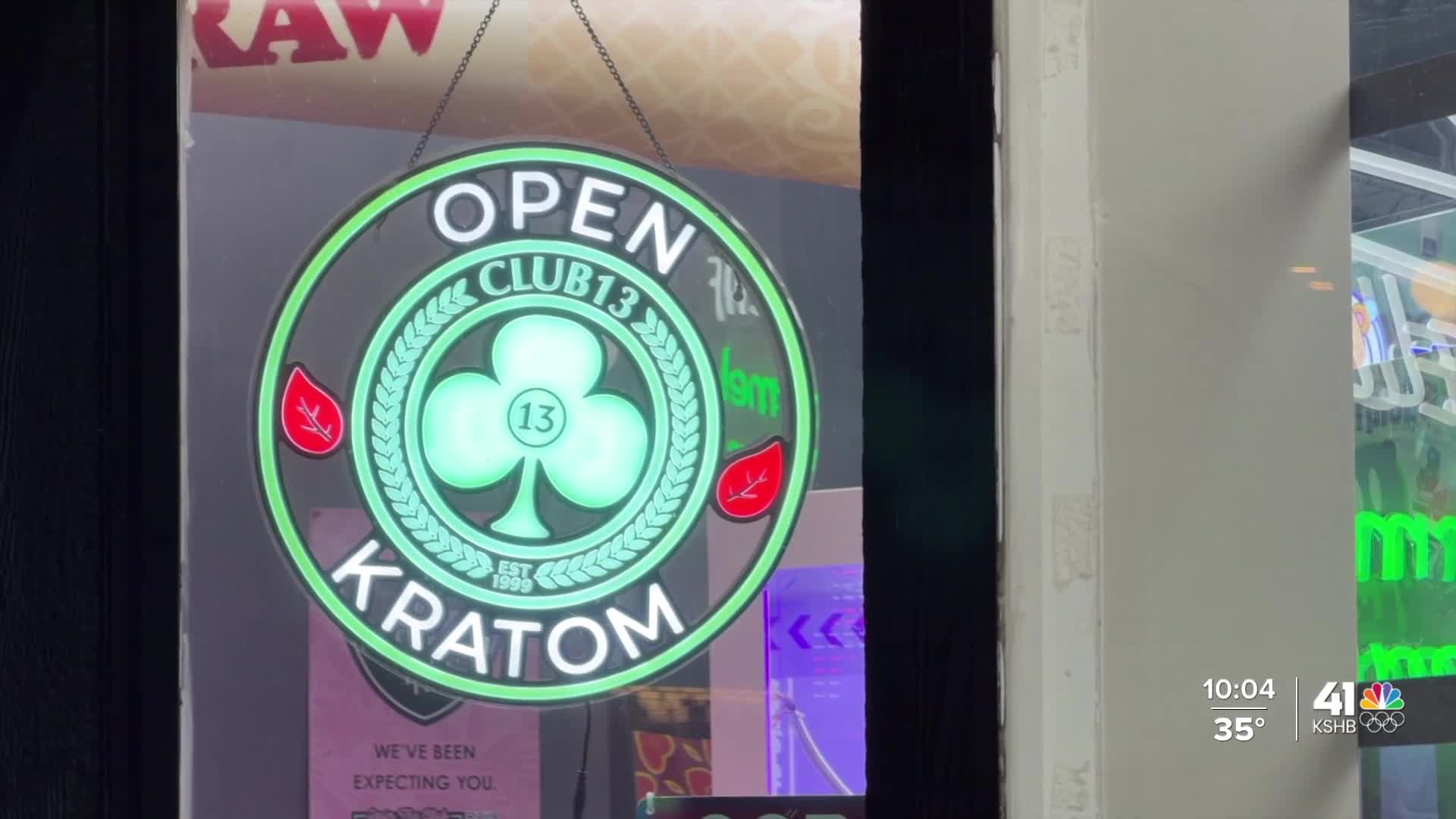
If you've never heard of kratom or 7-OH, it's not that hard to find in the metro. Hundreds of gas stations, convenience stores and smoke shops sell the products.
But kratom and 7-OH-related incidents can be difficult to track.
"This impacts all of us," Daniel Neill said. "These places are right within all of our communities, and it needs to be addressed."

Neill is the executive director of the Midwest High Intensity Drug Trafficking Area (HIDTA), a federal agency under the president's office that tracks drug trends in the Midwest and U.S. He explained a drug testing lab in Lenexa, Kansas, has seen a significant increase in 7-OH testing.
"They're seeing more people test positive for 7-OH than they are methamphetamine and marijuana. That's a big deal," Neill said.
Out of all the Midwest counties in Iowa, Kansas, Missouri, Nebraska, North Dakota and South Dakota, two Kansas communities were among the top 10 counties with the highest rates of EMS encounters for kratom and 7-OH-related overdoses.
Johnson County and Segwick County both had upwards of 25 calls for kratom and 7-OH-related overdoses between January 2023 and April 2025.
"The statistics reveal a notable upward trend in kratom/7-OH-related emergency responses, both regionally and nationwide," HIDTA's report stated.
The Kansas Department of Health and Environment reported 12 kratom-related overdose deaths in 2024 (about 2.2% of all overdose deaths), 21 kratom-related overdose deaths in 2023 and 25 kratom-related overdose deaths in 2022.
Missouri's Poison Control received 47 exposure reports for the products from January 2025 to September 2025, with one person needing hospitalization.
Kansas City, Missouri, announced one overdose death last week where kratom was involved. A spokesperson with the mayor's office confirmed to KSHB 41 News the primary psychoactive alkaloid found in kratom, mitragynine, was identified as one substance in a polysubstance overdose death.
Because 7-OH and kratom aren't regulated, Neill said some agencies aren't routinely testing it or tracking it.
"I think that the numbers could be a lot higher," Neill said. "The testing to determine whether someone's died of a drug overdose may go unnoticed because it's not scheduled and it's not regulated."
Health departments in Kansas and Missouri advised citizens to stay away from 7-OH due to its opioid-like effects and lack of federal testing for long-term effects.

"Some of [our] patients might have started [7-OH] to get off the opiates but are struggling with a bigger addiction now," said Dr. Roopa Sethi, an addiction psychiatrist at the University of Kansas Health System. "The withdrawal will be very similar to an opiate. They will have hot and cold sweats, nausea, vomiting and diarrhea."
That's why Missouri Rep. Bill Allen (R-District 17) prefiled a bill to place 7-OH on the Schedule I substance list. He explained in an email several of his constituents in the Northland had reached out, concerned about the effects.
"This is a measured approach — it targets dangerous high-potency kratom extracts while allowing traditional kratom leaf products to remain legal," Allen said. "This is a bipartisan issue. With enough public support, we can move quickly, but people need to contact their state representative and state senator. Their voices really do matter."
The FDA is currently taking steps to regulate 7-OH as a Schedule I substance. The recent regulation attempts, including Missouri's scheduling bill and the FDA's actions, specifically target the synthetic version, 7-OH, and not traditional kratom.
—