

KANSAS CITY, Mo. — KSHB 41 reporter Lily O’Shea Becker covers Franklin and Douglas counties in Kansas. Share your story idea with Lily.
—
A genetic genealogy expert says one DNA entry narrowed the investigation into David Zimbrick's alleged connections to two sexual assault cold cases involving children in Lawrence.
The Lawrence, Kansas, Police Department (LPD) worked with Parabon NanoLabs to identify the family tree of the DNA profile obtained from a crime scene at Naismith Valley Park in 2000.
Zimbrick, 58, was arrested on Dec. 29 and charged with one count of aggravated criminal sodomy and one count of rape in two cases from 2000 and 2003. The victims, a girl and a boy, were between 7 and 10 years old.
RELATED | Police: Cigarette butt, forensic genetic genealogy connect man to sex crimes from 25 years ago
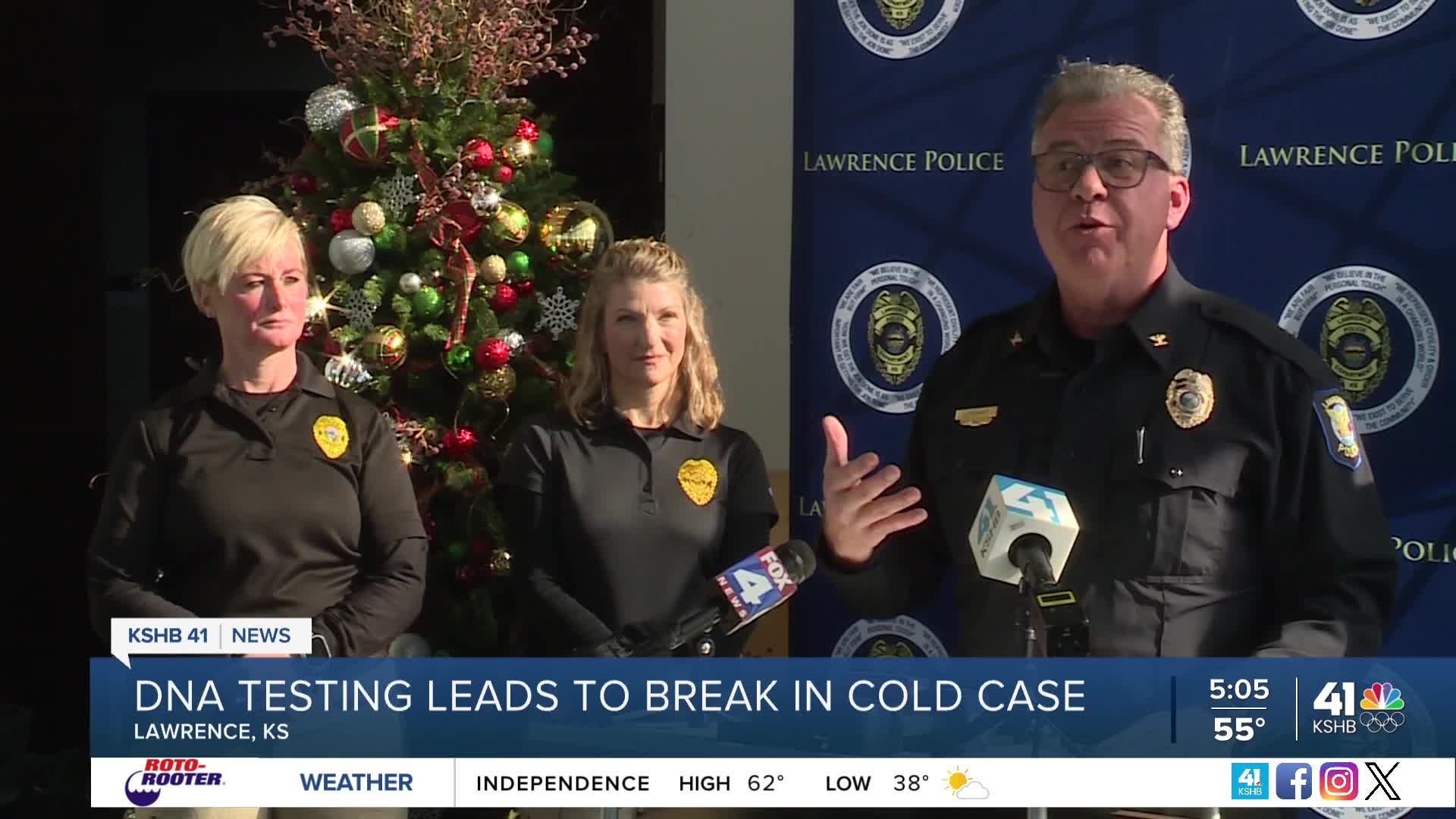
Statutes have been changed to allow flexibility in cases with DNA evidence. LPD chief Rich Lockhart said Kansas law allows officials to charge people within a year of DNA evidence connecting them to a crime.
The spokesperson for LPD told KSHB 41's Douglas County reporter Lily O'Shea Becker since the department publicly identified Zimbrick at a press conference in December, detectives have received new tips. LPD is working to determine whether those leads are connected to Zimbrick.
The victim of the August 2000 case reported their offender was smoking a cigarette, according to LPD. A now-retired detective collected cigarette butts, including one that was still smoldering, from the scene of the crime.
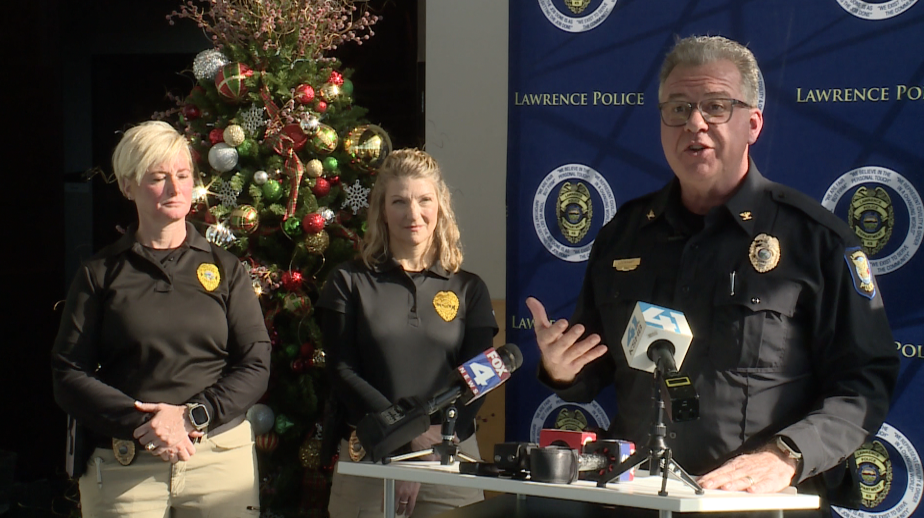
“Unknown to the officers at the time, these cigarette butts would become key pieces of evidence," Lockhart said at a Dec. 30 press conference.
A DNA profile was obtained from one of the cigarette butts. That profile was entered into CODIS on Nov. 16, 2001, but police say they never got a hit on it.
Sexual evidence from the 2003 crime was collected and submitted to the Kansas Bureau of Investigation (KBI), according to LPD. In September 2015, a DNA profile was obtained from that evidence and submitted to CODIS.
KBI told LPD the DNA profiles from the 2000 case and the 2003 case matched. Detectives were still unable to identify who that DNA belonged to, per LPD.
In 2019, detective Amy Price, who worked the case since 2000, began looking into forensic genetic genealogy. She worked with KBI and Parabon NanoLabs to have DNA evidence processed. LPD says a sample was sent to Parabon NanoLabs in February 2020.
By March 12, 2020, the investigative genetic genealogists successfully genotyped the DNA sample from the 2000 case, according to LPD.

CeCe Moore, chief genetic genealogist at Parabon NanoLabs, leads a team of four genetic genealogists who work with law enforcement agencies across North America to provide leads. The lab has helped solve 365 cases in about seven years, according to Moore.
“We have dozens and dozens of violent criminals that we’ve helped to get behind bars," Moore said. "We have seen these cases go through the court systems over the last seven years, in many different iterations, but in all cases the judges have ruled that this is a legitimate investigative lead.”
Moore said her team initially identified a third cousin of the DNA profile provided by LPD.
“In this case, we got really fortunate that a new, closer match came in as it was being worked," Moore said. "That really helped point us in the right direction."
Because of this new entry, Moore said her team was able to identify a possible grandparent of the DNA profile.
"We already had family trees, but that new match helped to point us to the right branches, and the right extended family, so we were able to advise the law enforcement agency and detective we believed he was going to be the grandson of one couple," Moore said.
Moore said Parabon NanoLabs can access three DNA databases. They are similar to popular DNA ancestry tools like 23andMe and Ancestry.com, but Parabon NanoLabs can not access those databases.
“It’s still only about 2 million people we’re working with, and over 50 million people have taken direct-consumer DNA tests, but we are barred from the largest databases," Moore said.
Databases like Family Tree DNA, GEDMatch, and DNA Justice allow customers to opt in to sharing their DNA with law enforcement agencies for cases like the high-profile Golden State Killer case.
“That’s one of the great things about genetic genealogy is, it is not a dead end because new people upload their DNA to these websites that allow us to utilize them every day," Moore said.
After identifying possible relatives as close as grandparents, Moore says it's on law enforcement agencies to follow through on that lead.
Lockhart said one of the samples the department submitted to Parabon NanoLabs cost $5,000.
"That pays for the lab processing and all the time we spend building those (family) trees backward and forward from the 1700s and forward to today, so there is a lot of effort and time put into the genealogy process," Moore said.
LPD said it began working with the Federal Bureau of Investigation's Investigative Genetic Genealogy Unit to obtain DNA samples from the possible family members Parabon identified.
That collaborative work led detectives to Zimbrick's biological mother. Detectives learned she became pregnant at 14 or 15 years old after she was raped, and she put the child up for adoption when he was born on Forbes Air Force Base in Topeka in 1967, according to LPD.

“It’s really important to do this face to face," Price said. "I think you really lose a lot of context and nuance when you just try to do things over the phone, and it’s really hard to ask for someone’s DNA over the phone."
In October 2025, Price and LPD detective Meghan Bardwell traveled to Santa Fe, New Mexico, to interview Zimbrick's biological mother.
“She informed us around 2005 she was contacted by this son and he identified himself as David Zimbrick," Lockhart said.
In November, Price confirmed the information provided by Zimbrick's biological mother after obtaining his adoption records through a search warrant.
His name led Price to an address for Zimbrick in Raytown, Missouri. On Nov. 20, Price and Bardwell interviewed him at the Raytown Police Department.
Through a search warrant, Price and Bardwell obtained a DNA sample from Zimbrick. He did not provide any other details about the investigation, according to LPD.
On Dec. 18, KBI informed Price that Zimbrick's DNA matched the DNA evidence from the 2003 case, per LPD.
The United States Marshall's Service arrested Zimbrick on Dec. 29. He was transported to the Jackson County Detention Center and was extradited to the Douglas County Jail on Dec. 31, according to the Douglas County Sheriff's Office (DGSO) booking log.
Zimbrick made his first appearance on Jan. 2 and posted a $100,000 cash or surety bond later that day, according to the spokesperson for DGSO.
Under his bond conditions, Zimbrick can not make contact with the alleged victims or non-law enforcement witnesses. He is also restricted from unsupervised contact with anyone under the age of 18, according to the DGSO spokesperson.
Zimbrick is set to appear again in court Tuesday morning at 10:30 a.m.
At the Dec. 30 press conference, Lockhart said there is no evidence of additional victims, but there is a possibility there are other cases.
Lockhart said LPD is currently using forensic genetic genealogy in other cases.
“You’re seeing a police department that is using technology that is fairly new to solve a case," Lockhart said. "Somebody probably thought they got away with it. We just want to let you know, if you committed crimes like this, eventually we’re going to catch up to you.”
—