

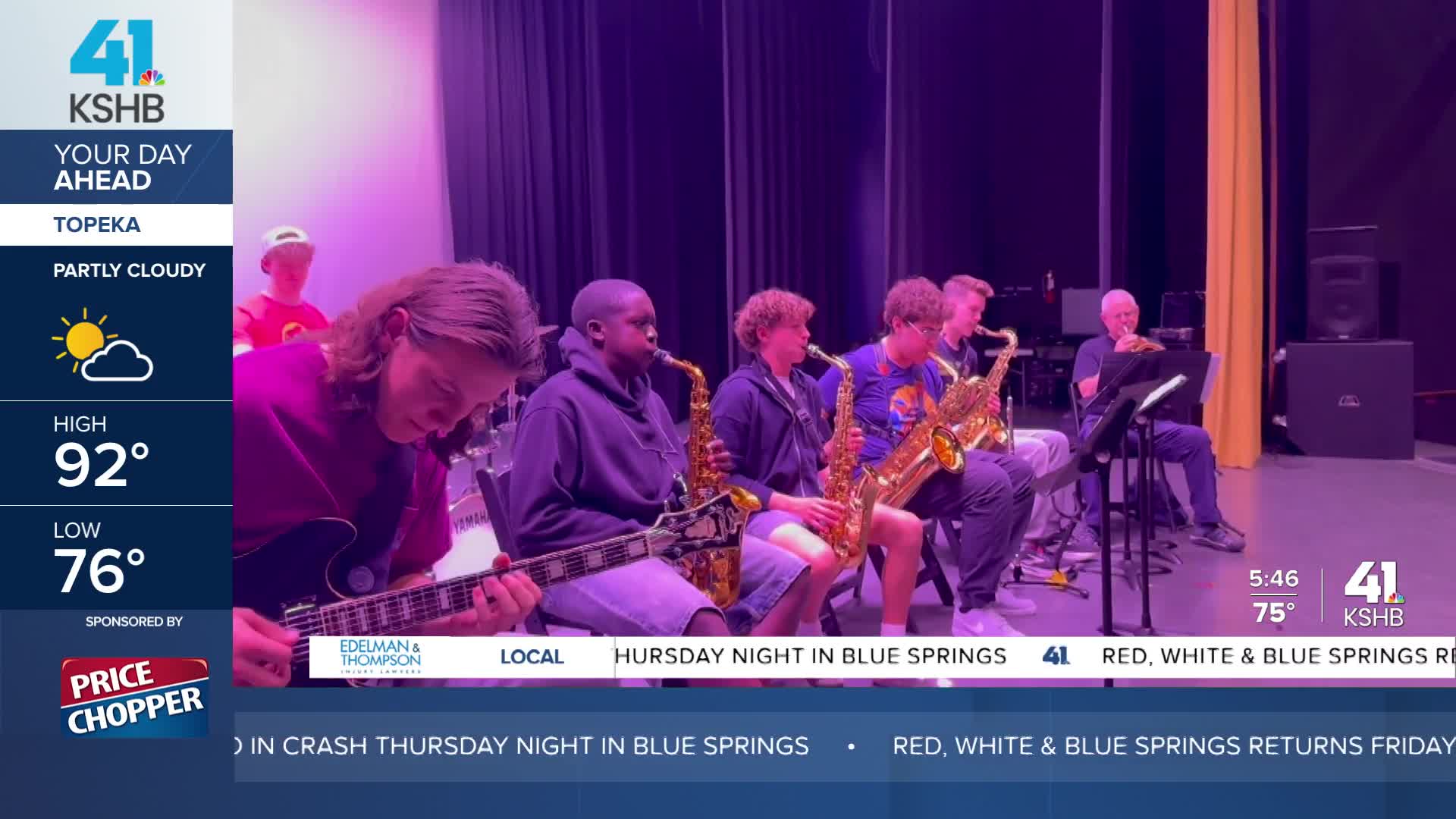



KANSAS CITY, Mo. — In the 18th and Vine District in Kansas City, Missouri, the sounds of hard-swinging bebop have echoed here for decades.
In 2015, KSHB 41 shared a special, 'Kansas City and All that Jazz' on the city's rich jazz history.
Now, that history is being passed down to future generations.
Clarence Smith is the manager of the Kansas City Jazz Academy, which is a part of the American Jazz Museum. Smith has been listening and playing jazz since he was a kid. He now uses his talents to teach and pass that passion on to young students.
"Once you get the jazz bug, you have it for life," Smith said.
That 'jazz bug' can be heard when you hear Smith play the drums.
You'll also hear it when pianist and Jazz Academy instructor, Charles Williams improvises on the piano.
The students with the Jazz Academy feel that bug too.
"It's a different feeling," Jazz Academy student, Kenyi Yoyo said. "There's no other feeling like jazz."
It's a genre that brings all walks of life together, and one of the heartbeats of Kansas City history.
"Kansas City just played an important role in the development of jazz," Smith said. Count Basie lived here prior to that for several years and when they left Kansas City, they took with them what we think of as the Kansas City sound. Charlie Parker who grew up in this neighborhood, who snuck out of his house at nighttime to go listen and hangout with all the music and musicians in this area, and eventually he is going to go on to become the founder of what we call modern jazz, which is Bebop.
History is embedded in the notes the Jazz Academy students play.
"This is just such a historic landmark for jazz, especially 18th and Vine," Yoyo said. "From Lester Young playing down here, Bennie Moten all of those big cats, you should really think about jazz when you came down here just based off of them."
Students Kenyi Yoyo, Steven Reynolds, and Tallulah Hoeft share how their love for jazz started.
"The Incredibles," Yoyo shared. "That movie really inspired me to play jazz."
"My dad tells me a story I used to walk around my house all the time banging on pots and pans, doing all that but I was doing it in rhythm," Reynolds said. "So they bought me a little Mini Tikes drum set and then they bought me a real drum set and I was playing that up. So they kinda just thought that was supposed to be my thing and so it was."
"My grandparents are jazz musicians and my grandpa is a saxophone player," Hoeft shared. "I've always looked up to him. I would be at their gigs every Friday."
At the Jazz Academy, the students not only learn the notes and keys, but how to feel the music and make it their own.
"Our primary purpose with jazz academy is to teach students how to improvise better," Smith said. "And that's the most important characteristic of jazz."
Yoyo says jazz is a feeling.
"It's a language for people, Yoyo said.
"Sometimes I can convey emotions musically better than I can with words," Reynolds said.
While it can be challenging, Smith says it's rewarding.
"The reward is this incredible music where people express themselves individually, that's the beauty of it," Smith said. "The journey to get there is most definitely worth it."
Including Yoyo, Reynolds and Hoeft, there are about 55 to 60 students a part of the Jazz Academy at the American Jazz museum. Its mission is to develop confidence, creativity and community through jazz, while honoring the legacy of Kansas City's rich jazz history.
To learn more about the Academy, click here.
![092126_KSHB_WX_480x360[61].jpg](https://ewscripps.brightspotcdn.com/dims4/default/79e7fad/2147483647/strip/true/crop/480x360+0+0/resize/960x720!/format/webp/quality/90/?url=http%3A%2F%2Fewscripps-brightspot.s3.amazonaws.com%2F6f%2F6d%2Fa3758caf4c0984b0ecf100f620d1%2F092126-kshb-wx-480x36061.jpg)