



KANSAS CITY, Mo. — KSHB 41 reporter Isabella Ledonne reports on stories in Overland Park, Johnson County and topics about government accountability. Share your story idea with Isabella.
—
The surveillance technology company, Flock, announced Thursday it is making some changes to operations as privacy concerns continue to grow.
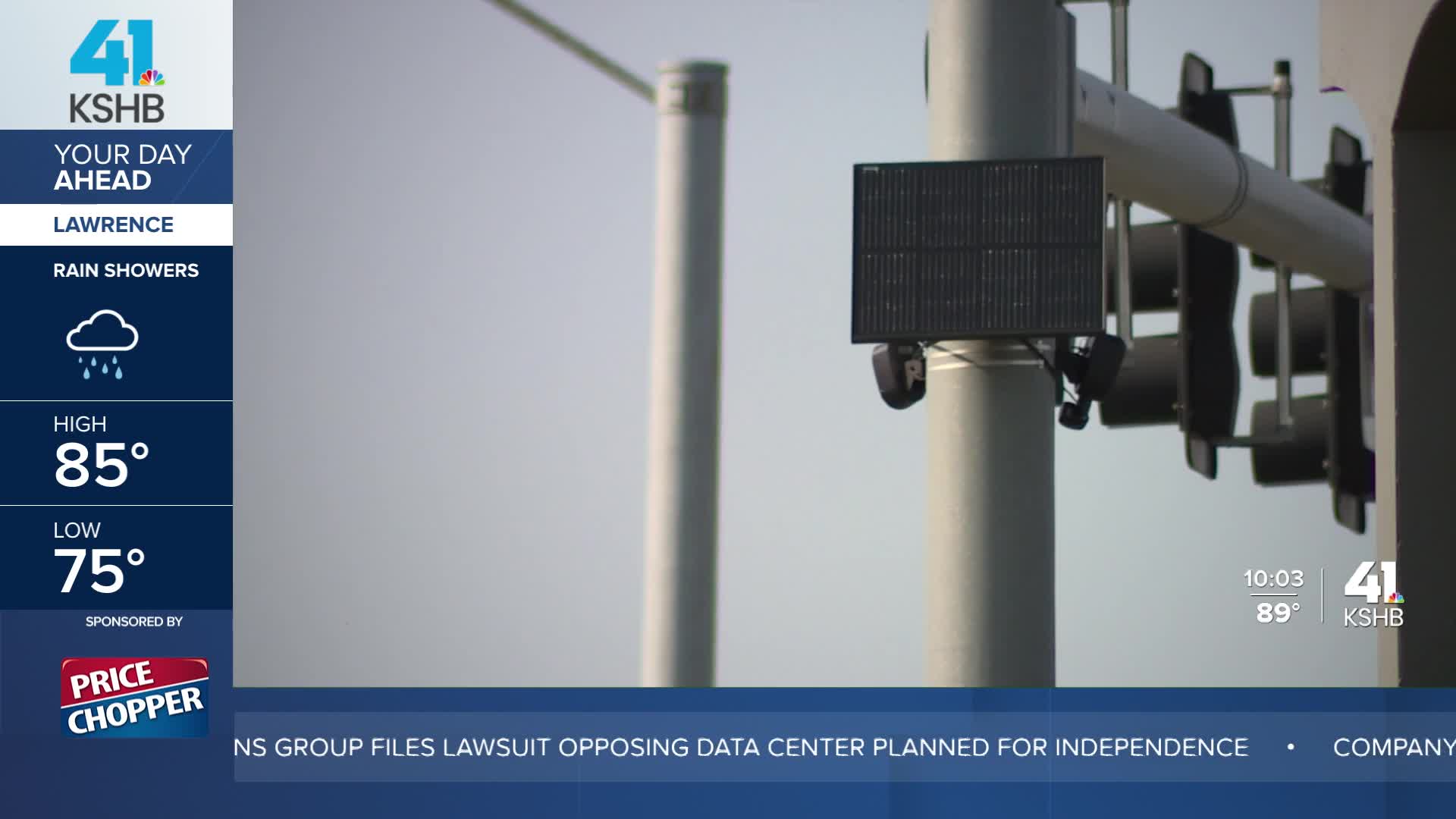
You may have seen the cameras around the metro area, mounted on poles, often with a solar panel attached. They read license plates and capture vehicle details which allows law enforcement to search through data bases for information on possible suspects.
However, many have issues with the Ai-powered surveillance.
Someone in Kearney, Missouri, cut down a Flock camera on Thursday, a city spokesperson confirmed. A different Flock camera was stolen in July in Platte County.
The 'DeFlock' movement is growing fast across across the country and across Kansas City. It's groups of concerned citizens speaking out against the surveillance cameras, calling on cities and law enforcement for transparency.
From the Northland to Lee's Summit, you'll probably find an automatic license plate reader (ALPR) at almost every intersection. It's left neighbors with many unanswered questions.

"Who installed them?" Lee's Summit resident Trace Kitzmann asked. "Who paid for them? Who has access to that data?"
Kitzmann launched a Facebook group, DeFlock Lee's Summit, which has gained more than 500 followers in two days.
"[The cameras] has raised more concern that none of us in the city, us taxpayers, got to vote on it, or even know that they were going up, or where they were going up," Kitzmann said.
His concerns align with many others in the metro who have noticed more automated surveillance cameras going up.

"I think there are a lot of privacy and data concerns that aren't necessarily being addressed in the best way," Blue Springs resident Rob Jestus said.
Blue Springs is Missouri's first 'Flock Safe City', dedicating $4.6 million to a 10-year-contract for advanced surveillance technology. His biggest question is who is watching the ones watching the Ai surveillance.
"If no one is tracking it, anyone can do anything they want," Jestus said.
Jestus took a page out of the watchdog playbook and created a website with all the records and documents he's found and obtained on the Blue Springs Flock cameras.
"I asked for data and was told we have no preexisting documentation," Jestus said. "I thought for a program they were investing $4.6 million into, they would have some sort of ROI for it or some sort of safety investigation," Jestus said.
In response to multiple documented cases of law enforcement officers nationwide abusing ALPR technology for personal reasons, Flock announced changes to user regulations and policy on Thursday.
The company will now require law enforcement departments to implement an audit tool that’s intended to flag abnormal search behavior. When the system detects abnormal behavior, the user would be locked out pending an internal review, according to the company.
Flock, which says its customers own the data that the cameras record, is also shortening the standard data retention window from 30 days to seven. It said it will allow data to be preserved for longer when it is evidence tied to a case number.
But not everyone is convinced it's a step in the right direction to address privacy concerns.
"Personally, I think it's mostly for show," Jestus said. "I don't think anything they've announced for changes is significant in any way."
KSHB 41 News reporter Isabella Ledonne asked KCPD, KCKPD, Lee's Summit Police and Blue Springs Police how the departments use ALPR cameras and if that information is shared outside their jurisdiction.
Blue Springs Police Department was the only agency to provide a response by the time of this publication.
"BSPD primarily uses our Flock cameras to investigate crimes, interdict wanted persons, and ID stolen vehicles and license plates," Deputy Chief Kyle Flowers said. "Information is shared through the web-based app to sworn members of our department in the form of "alerts" when the system identifies a wanted vehicle. BSPD does share information with other jurisdictions on the Flock network, these agencies can be found on our transparency portal."
Deputy Chief Flowers confirmed that the cameras have helped police identify and arrest suspects in crimes, including homicide. Police report they have had some minor tampering with cameras but 'nothing that raises major concerns'.
More than 5,000 law enforcement agencies use Flock technology, which is a cause for concern for the people being watched.
"It's scary, it's really scary," Jestus said. "I think a lot of these technologies could be used for positive benefit, but without oversight, without audits, without proper transparency to it, it just creates a darkness that leads to a fertile ground for corruption."
Earlier this year, people living in Weston, Missouri, raised their voices over the city installing Flock cameras.
For months, neighbors packed city council meetings expressing their disapproval of the system. The growing pressure eventually resulted in the city voting to halt installation.
Weston leaders tell KSHB 41 News there are no plans for any future Flock cameras to be installed in the city.
—

![092126_KSHB_WX_480x360[61].jpg](https://ewscripps.brightspotcdn.com/dims4/default/79e7fad/2147483647/strip/true/crop/480x360+0+0/resize/960x720!/format/webp/quality/90/?url=http%3A%2F%2Fewscripps-brightspot.s3.amazonaws.com%2F6f%2F6d%2Fa3758caf4c0984b0ecf100f620d1%2F092126-kshb-wx-480x36061.jpg)