



JEFFERSON CITY, Mo. — The Missouri Supreme Court on Tuesday upheld a mid-decade redistricting plan that gives Republicans an improved chance at winning an additional U.S. House seat in this year’s midterm elections.
The decision marks a legal victory for President Donald Trump in a nationwide redistricting battle. But it may not be the final word. Opponents have submitted more than 300,000 petition signatures in an attempt to put the new map to a statewide vote.
Missouri’s Republican-led Legislature approved new U.S. House districts in September at the urging of Trump, shortly after Texas Republicans also redrew their congressional districts. Trump is hoping the new districts could help the GOP hold on to its narrow majority in the House, where Democrats need to gain only a few sets in November to win control and impede Trump’s agenda.
"The Missouri Supreme Court has reinforced what we've known all along - the Missouri First Map and mid-decade redistricting are constitutional," Missouri Attorney General Catherine Hanaway said in a statement Tuesday afternoon.
The state's Republican governor, Mike Kehoe, who signed the maps into law last summer, was similarly happy with Tuesday's ruling.
The Missouri Supreme Court today affirmed the General Assembly’s authority to update Missouri’s congressional districts in the Missouri First Map.
— Governor Mike Kehoe (@GovMikeKehoe) March 24, 2026
Great work by @AGCHanaway and her team in securing another win.
Opponents had argued that Missouri’s constitution allows redistricting only immediately after a census — not in the middle of a decade. But the state’s high court rejected that argument in a 4-3 decision, concluding there was no explicit prohibition against the Legislature doing redistricting more often.
"Today's narrowly decided-upon opinion to uphold a partisan map backed by special interests in Washington is a disappointment for all Kansas Citians," Kansas City, Missouri, Mayor Quinton Lucas said in a statement.
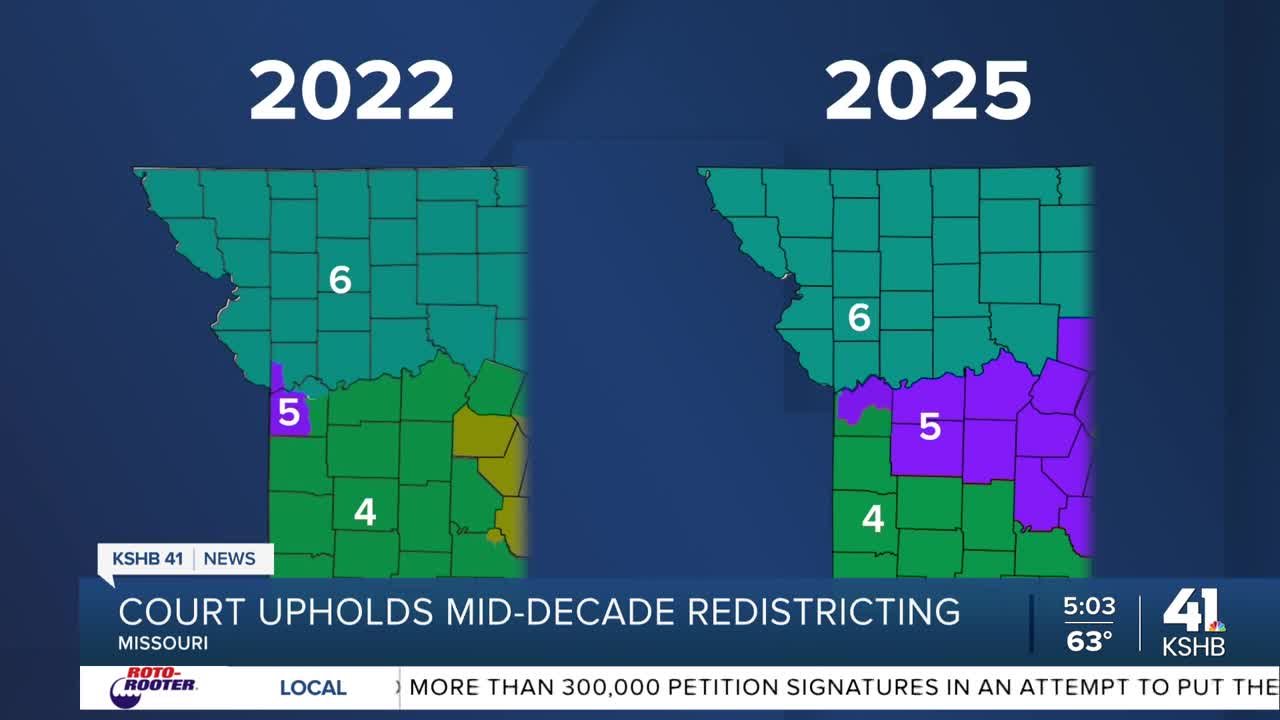
The redrawn maps split congressional districts in the Kansas City area.
"The move to redistrict was never about good governance, sound policy, or listening to diverse viewpoints in Kansas City," Lucas continued. "Instead, special interest redistricting has always been an effort to disenfranchise hundreds of thousands of voices in the halls of Congress."
U.S. Rep. Mark Alford (R - 4th District) will see his district now include a greater part of the Kansas City area south of the river.
🚨IT'S OFFICIAL: The AMERICA FIRST Missouri congressional map is upheld!
— Mark Alford 🇺🇸🇺🇸🇺🇸🇺🇸 (@markalfordkc) March 24, 2026
The Missouri Supreme Court just confirmed what we’ve said all along: our legislature acted within its constitutional authority to deliver fair, lawful representation for the people of Missouri.
This is a…
Missouri currently is represented in the U.S. House by six Republicans and two Democrats under a map passed in 2022 after the most recent census. The new map is intended to help Republicans win a Kansas City-area seat currently held by Democratic U.S. Rep. Emanuel Cleaver by reassigning portions to two neighboring districts and stretching the remainder into Republican-heavy rural areas.
A trial court rejected a separate legal challenge last week contending that the new districts violate state requirements to be compact. That decision also is being appealed to the Missouri Supreme Court.
After Texas and Missouri adopted new congressional districts, Republican-led North Carolina and Ohio also revised their districts in a way that could help Republicans gain seats. But voters in California countered in November by approving new districts that could help Democrats win more seats.
In November, a Utah judge adopted a redistricting plan that could help Democrats win one of the state’s four U.S. House seats, after ruling that the Republican-led Legislature had circumvented anti-gerrymandering standards passed by voters. Democratic lawmakers in Virginia also have taken a step toward mid-decade redistricting by referring a measure authorizing it to the April 21 ballot. The Virginia Supreme Court is considering a legal challenge seeking to invalidate the measure.
"By allowing this partisan gerrymander to stand, the Court has given politicians in Jefferson City the green light to suddenly redraw congressional maps whenever it benefits their party, even if it means carving up communities like Kansas City to dilute the voices of voters," Missouri Democratic Party Chair Russ Carnahan said. "This enables and continues a long trend of chaotic outcomes - in prices, in trade decisions, and in our democracy, that destabilize the world that Americans and Missourians make decisions in."
![092126_KSHB_WX_480x360[61].jpg](https://ewscripps.brightspotcdn.com/dims4/default/79e7fad/2147483647/strip/true/crop/480x360+0+0/resize/960x720!/format/webp/quality/90/?url=http%3A%2F%2Fewscripps-brightspot.s3.amazonaws.com%2F6f%2F6d%2Fa3758caf4c0984b0ecf100f620d1%2F092126-kshb-wx-480x36061.jpg)