


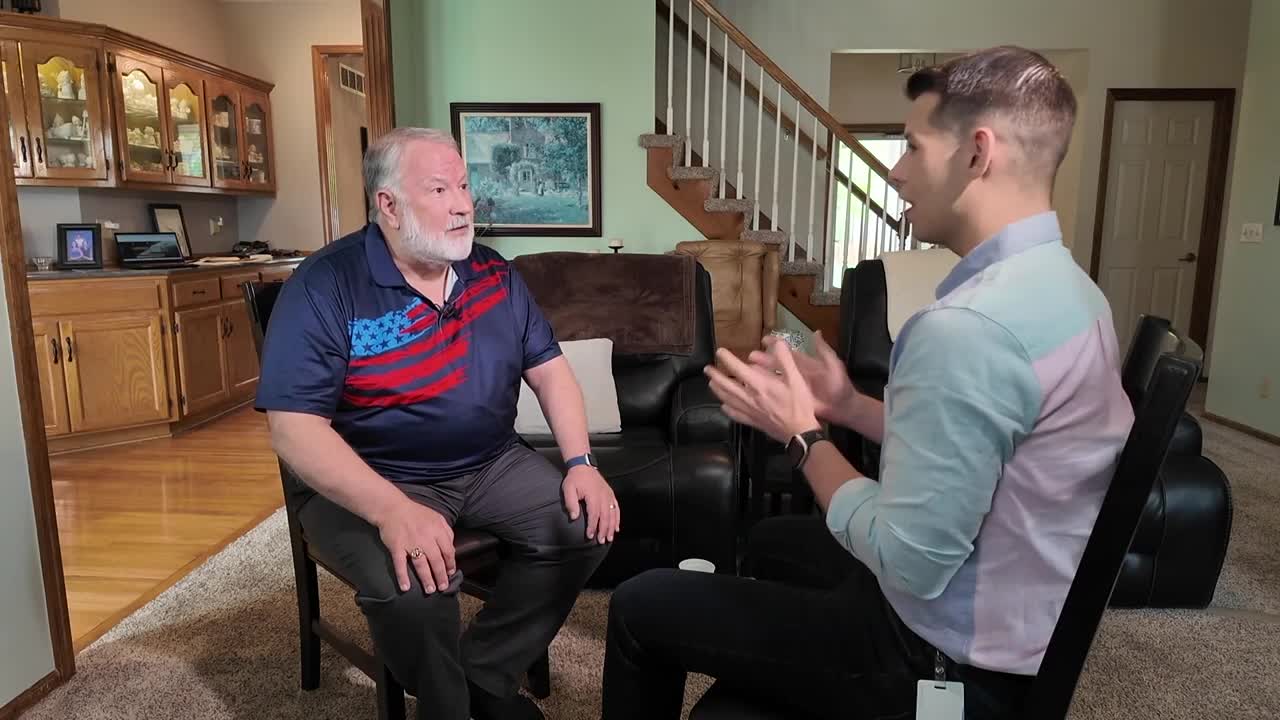


KANSAS CITY, Mo. — KSHB 41 News reporter Braden Bates covers parts of Jackson County, Missouri, including Lee's Summit. Send Braden a story idea by e-mail.
A complicated temperature problem ahead of NASA's Apollo 11 moon landing mission was solved by a Kansas City man who found inspiration for his solution at a local barbecue restaurant.
Harold Finch was an ambitious man.
While preparing for the mission, NASA sent out a Request for Proposal (RFP) trying to find a solution to keep spacecrafts from getting too hot or too cold.

Going against large companies like Boeing, Finch's background studying temperature piqued his interest in the NASA request.
The problems were the unequal temperatures the spacecrafts face after leaving Earth orbit on their way to and from the moon.
"The sun side of the spacecraft will be 300 degrees Fahrenheit," Greg Finch, Harold Finch's son, said. "And when you get closer to the moon, it will rise 380 degrees Fahrenheit. That’s oven temperatures. Cooking temperatures. But at the same moment on the shade side of the same spacecraft, it will be 240 degrees below zero"
One day while getting lunch at a Gates Bar-B-Q near the Country Club Plaza, something caught his eye.
"I just had an a'ha moment and said, 'My golly, that's what we need to do in space. The mathematics and science behind it was extremely complex,"' Harold Finch said in a 2019 interview with KSHB 41 News.
He noticed how a rotisserie evenly distributed heat across the cooking meat. He realized this principle could be applied to spacecraft traveling to the moon to regulate extreme temperatures.
The slow rotation of the spacecraft became a groundbreaking discovery. It was nicknamed the "Barbecue Roll" in honor of its Kansas City origins.
The technique remains in use for modern space missions.
"Today, Artemis and Orion capsules are still using the Barbecue Roll," Greg Finch said.
Harold Finch passed away in 2023, but his son is keeping his legacy alive.
"It was amazing," Greg Finch said. "My dad was the best show and tell ever."
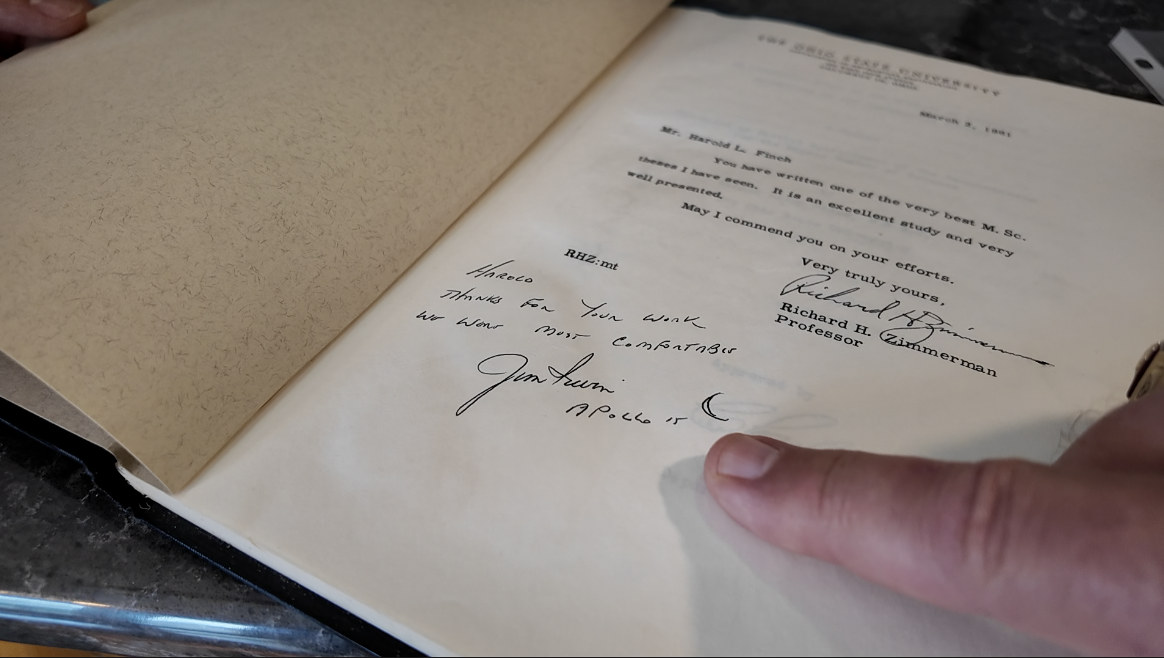
Greg said his father's dream of space started at a young age.
"If Superman could fly through space, well, he knew that people could fly through space, too," Greg said.
That dream persisted even when Harold Finch faced discouragement as a child. That was before anyone had ever made it to space.
"He doodled rocket ships one day all over his math assignment in 5th grade, and the teacher back then, schools were very strict," Greg said. "She took it, crunched it up into a ball, and threw it right into the trash can. And she said, 'Harold, don't you know people will never fly through space."'
Despite the negativity, Harold Finch continued to pursue his ideas.
"He was a guy that rarely had what the world would say was qualifications to do anything he ever did in life.," Greg Finch said. "He just had a dream and he was a dreamer."
Finch surrounded himself with the top scientists. After being awarded the job at NASA, Finch's dreams never stopped.
Greg said his dad was humble. People around them often didn't know his history or the history that he made.
While a successful scientist, educator, and entrepreneur, the role Harold cherished the most was being a father.
That love was equally reciprocated.
"Another legacy that I love even more," Greg Finch said. "That brilliant rocket scientist, that sweet man who was a gentle man. My siblings and I got to call him Dad, and that's the coolest thing ever."
Finch says he will always love his father's invention.
"I love that a Kansas City boy invented something that will be used for what used to be considered sci-fi, but it will be used in reality," Greg Finch said.
This story was reported on-air by a journalist and has been converted to this platform with the assistance of AI. Our editorial team verifies all reporting on all platforms for fairness and accuracy.