



KANSAS CITY, Mo. — KSHB 41 reporter Megan Abundis covers Kansas City, Missouri, including neighborhoods in the southern part of the city. She also focuses on issues regarding scams. Share your story idea with Megan.
—
A Missouri constitutional amendment would put the state on a path to eliminate the state income tax.
Missouri Gov. Mike Kehoe put it on the ballot and calls it his top priority, arguing it will make the state more economically competitive. But a Missouri appeals court rewrote the ballot language to make clear that the move gives lawmakers the ability to start new sales taxes without restrictions.
Critics argue the move would just create new taxes and could reduce state revenue for social services like schools, community programs and various nonprofits.
On Aug. 4, Amendment 5 will be on the ballot. A "Yes" vote would phase out and eliminate Missouri's individual income tax and give lawmakers the authority to bypass current constitutional restrictions and create new sales taxes.
At Newhouse, a Kansas City, Missouri, domestic violence shelter, CEO Courtney Thomas is urging voters to reject the amendment.
“I think tax reform deserves very thoughtful discussion and the timing is critical. So when our state is already experiencing violence at significant rates, housing scarcity at highest volumes, and we think about eliminating income tax, what’s going to happen to those infrastructures and non-profit organizations that are meeting this community need through services?" Thomas said.

"Newhouse has helped me rebuild my entire life," one survivor said.
The survivor and her children found refuge at Newhouse.
"Being in a safe atmosphere, having counseling services, therapy services available, just being able to go to sleep and not have to worry if someone is going to harm me or my children or defend myself in the middle of the night," she said.
Thomas said that after federal funding cuts, inflation and a tough budget cycle, calls for domestic violence help are still higher than ever. In 2025, Newhouse saw a 35% increase in the number of calls for help, as KCMO had a record number of domestic violence homicides.
Newhouse relies on tax credits — nearly $3 million in donations over the last five years.
“In order for the public to leverage those tax credits, they have to have Missouri tax liability, so one of our tax credits is .70 cents on the dollar, so when a member of the public donates $1,000, then they get $700 of that money back to take off that Missouri liability," she said.
Thomas believes that if Missouri's state income tax is eliminated, income tax liability disappears with it. She said the tax credit benefit would become irrelevant if people no longer owe the state, lessening the incentive to give.
"When you think about income tax eliminations, the loss of incentives through tax credits, you're talking about service elimination, you're talking about people's lives who will no longer have the safety that organizations like Newhouse provide to them," Thomas said.

Even as demand grows, Thomas is grappling with the prospect of social services being forced to do more with less.
“How do we ensure that the fundamental and core purpose of our work isn’t impacted. The reality is it will be in some capacity, maybe we can’t serve as many, maybe we can’t house as many here, but we will never abandon our true purpose," Thomas said.
Thomas said Missouri ranks eighth in the nation for violent crime, Kansas City ranks first in Missouri cities for the volume of domestic violence calls, and Missouri ranks in the top ten of the deadliest states for women to be killed by their abusers.
The concern comes as Gov. Kehoe approved a state budget that significantly cuts funding for victim services like Newhouse. For years, Missouri's budget allocated $25 million for crime victim services. That figure was cut to zero before $9 million was added back.
"It's a very scary equation," Thomas said. "I'm so glad to see that the $9 million reinstated to General Revenues for Crime Victim Services remained, along with the $1 million of DVSS funding. While agencies will still see cuts to their VOCA funding, it won’t be as catastrophic as was anticipated if all funds were eliminated. Agencies will experience around a 16% cut vs anticipated catastrophic cuts of 38%."
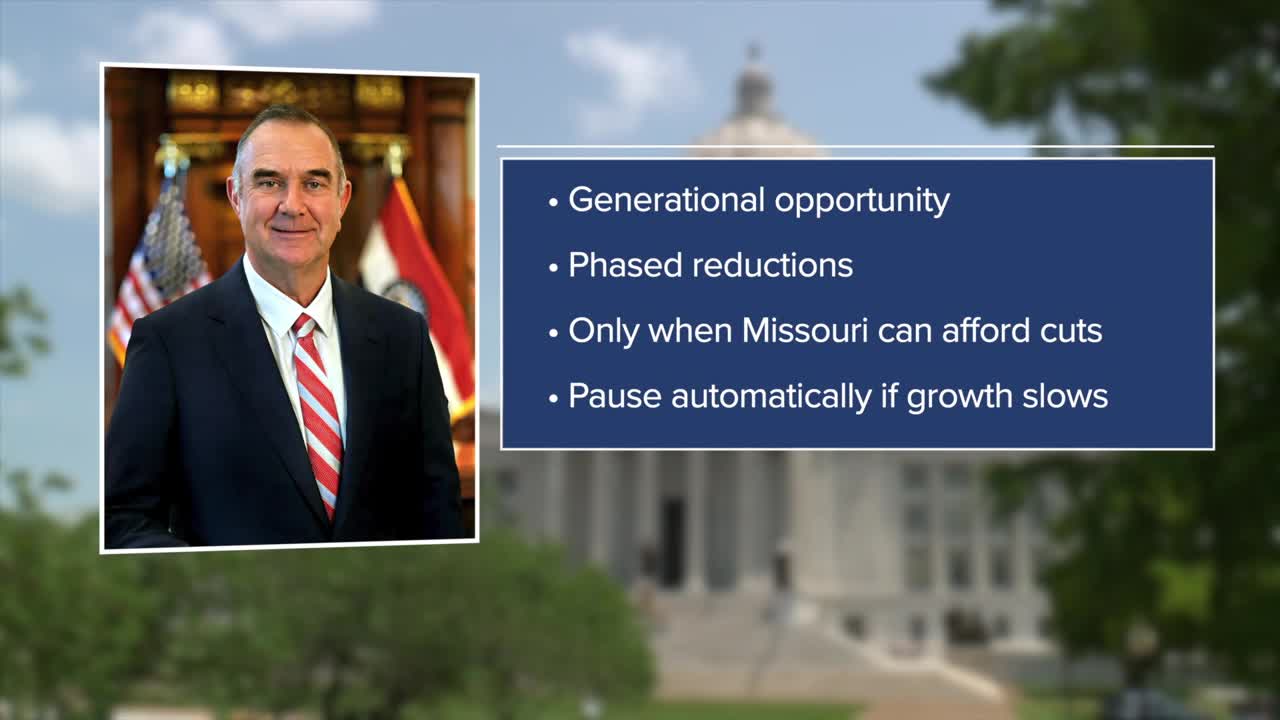
Gov. Kehoe's communications team said the income tax elimination would happen through phased reductions, would only occur when Missouri can afford them, and would pause automatically if economic growth slows.
Amendment 5’s income tax phase out is tied directly to revenue growth through revenue-triggered reductions. Income tax cuts would only happen when Missouri can afford them, and they pause automatically if growth slows. Modernizing the tax code and adjusting tax rates would capture current untaxed revenue and redirect it to fund Missouri’s income tax reduction. It is false to claim that state funding will be cut due to Amendment 5.
For decades, Missouri has worked to reduce the tax burden on working families while maintaining a balanced budget. Phasing out the state’s income tax is a generational opportunity that builds on that momentum while taking a bold step toward creating a stronger, more competitive economy that is built for the future.
Missouri's current individual income tax rate is 4.7%.
You can read the full fiscal note for Amendment 5 here.
—

![092126_KSHB_WX_480x360[61].jpg](https://ewscripps.brightspotcdn.com/dims4/default/79e7fad/2147483647/strip/true/crop/480x360+0+0/resize/960x720!/format/webp/quality/90/?url=http%3A%2F%2Fewscripps-brightspot.s3.amazonaws.com%2F6f%2F6d%2Fa3758caf4c0984b0ecf100f620d1%2F092126-kshb-wx-480x36061.jpg)