

GOWER, Mo. — KSHB 41 anchor/reporter JuYeon Kim covers agricultural issues and the fentanyl crisis. Share your story idea with JuYeon.
—
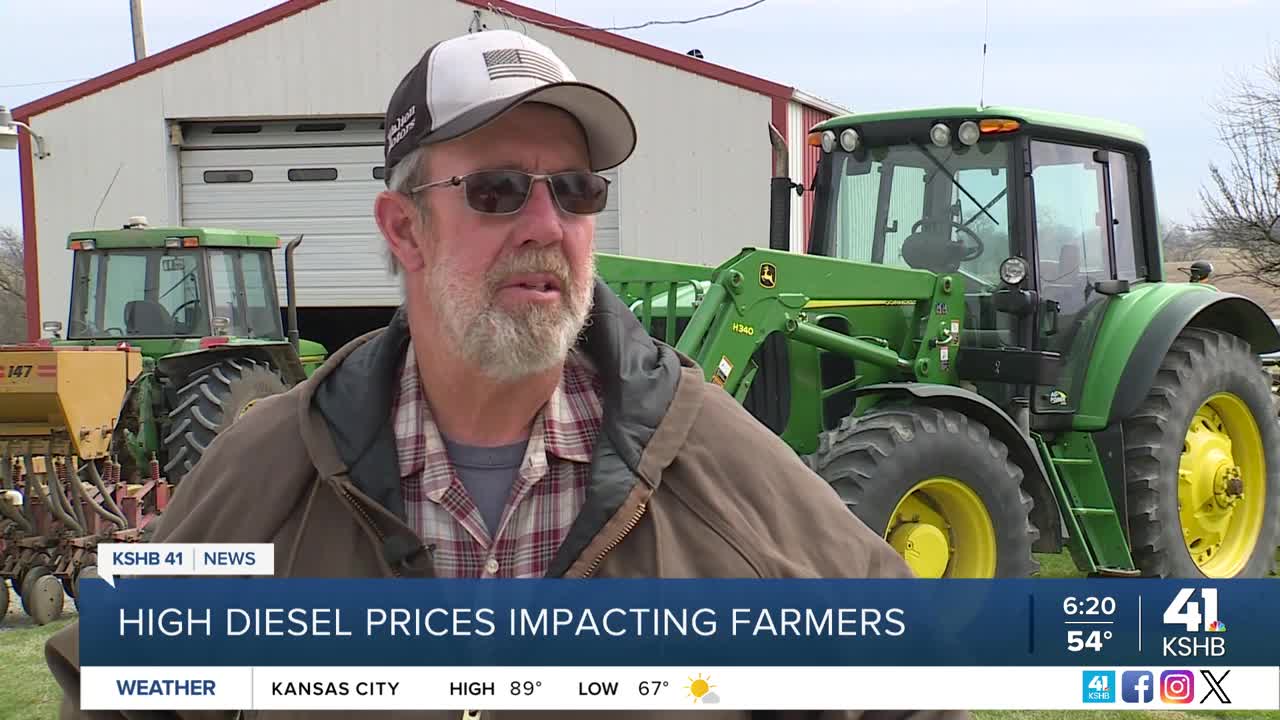
Diesel prices remain up due to the ongoing conflict between the United States and Iran, impacting local farmers in deep and unique ways.
“We use fuel on a day-to-day basis in agriculture, just like you do in driving your cars,” said Ray Schwarz, of Schwarzweis Farm in Gower, Missouri. “We do raise grain, we do raise forage, we raise cattle along to harvest the forage.”
For more than 70 years, the Schwarz family has been weathering the ups and downs of farming. And high diesel prices are their latest challenge.

“Whether it’s in the tractors here behind me, whether it’s in oil and so forth that we use in the engines, we use fuel when we harvest crops, plant crops. It’s all part of daily business,” Schwarz said. “This nation wouldn’t get along very good without fuel unless, you know, you desire to go back to farming with horses.”
He believes one of the biggest surprises this spring will be additional surcharges on some fertilizers and seeds, which are often tied to transportation costs.

Ben Brown, University of Missouri’s state specialist for row crop science, says the burden on farmers is greater because these higher prices come right as producers are getting ready to start planting.
“Especially for producers that haven’t pre-bought or bought their fertilizer ahead of time, it is becoming a little bit challenging to find one," Brown said. "Even suppliers can provide that fertilizer product. If they are, sometimes the prices are a jump of 10 to 15 percent."

And many of them did not buy ahead because they were expecting input prices to be lower this season. By the way, the Middle East accounts for 10 to 15 percent of all global fertilizer trade.
“When this is all said and done, there’s going to be a lot of hindsight,” Brown said.
While crop insurance can help, Brown says that because rates are set in February for crops like soybeans and corn, many agencies used market prices from several weeks earlier, just before they rose.

So, the risk management program may not be as practical as usual.
As planting season begins, Brown anticipates many farmers will change what they grow to save on fuel. For example, some may move away from high-input crops such as corn, cotton and rice to soybeans.
It is a tactic that Schwarz has taken up as well, especially given market trends.

“I’ve converted some acreage back to hay that would’ve been or could’ve been grain,” Schwarz said.
Even though there are lots of would-haves, could-haves and should-haves, Schwarz says he knows a thing or two about appreciating and investing in things that last — like his flip phone, which he is proud to own.

“I can assure you, I’m not the only farmer in the country that has one of these,” Schwarz said. “I’m kind of known across the internet as the 'Flip Phone Farmer.'”
—