

KANSAS CITY, Mo. — KSHB 41 News anchor Caitlin Knute is interested in hearing from you. Send her an e-mail.
—
For roughly one year, a Kansas City, Missouri, trail left residents and outdoor enthusiasts living in fear.
There were a total of six homicides between 2016 and 2017, four of those on or near Indian Creek Trail.
Now, 10 years after the first fatal shooting, the trial for accused serial killer Fredrick Scott, 31, has started after years of delays.
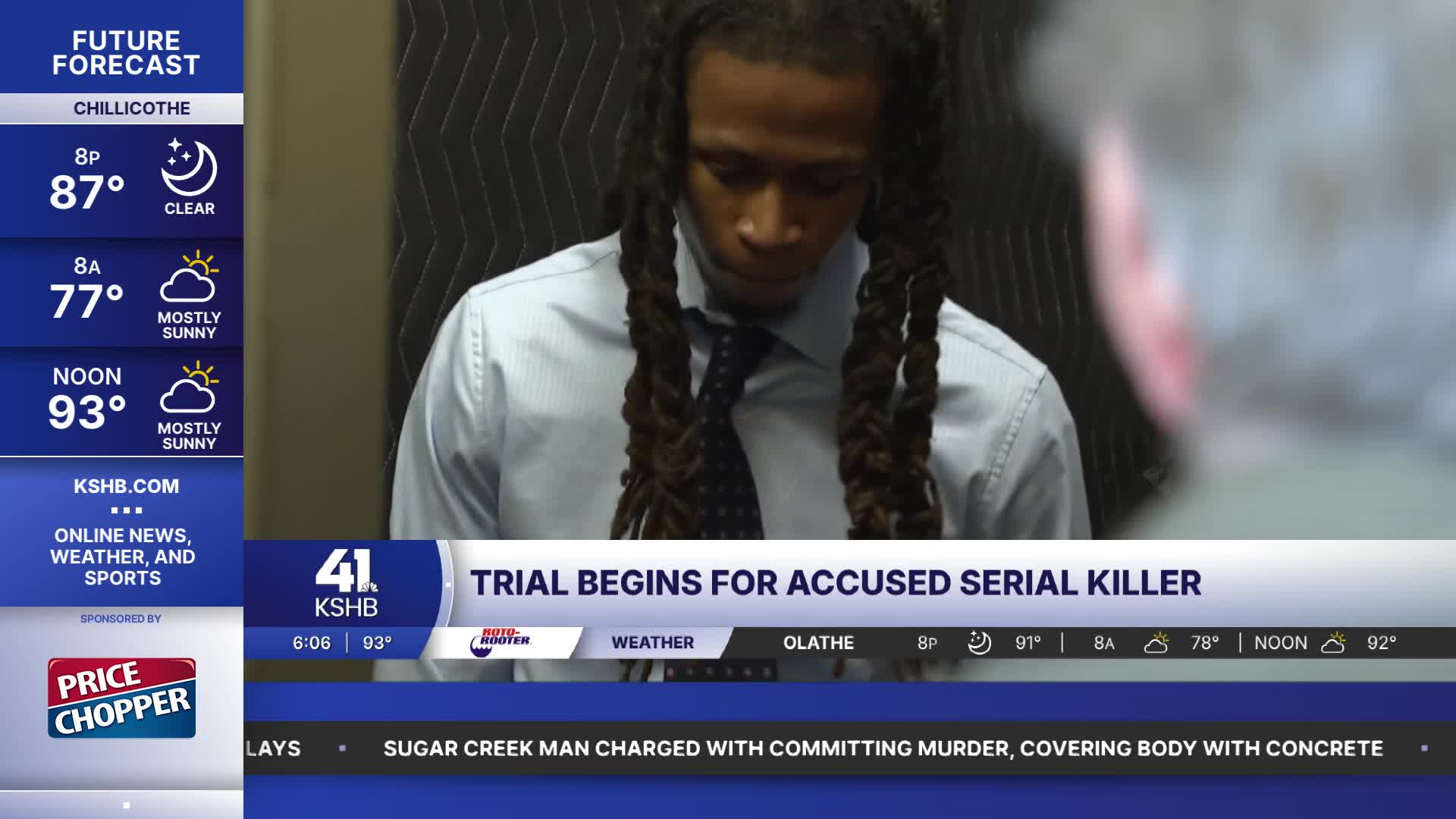
During day, one, Scott appeared in court in a light blue collared shirt with a tie and khakis. His mother sat in the front row behind him, although she left during the first break of the day and didn’t return. The other side was packed with friends and family of the victims, including the Derby family, the Palmer, family, and members of the Lennox family, just to name a few I spoke to.
The jury is made up of five men, and 10 women. Jurors were warned repeatedly not to do their own research on the case and not to post text or share anything about the trial.
To better understand the charges Scott is facing, here is a look at the timeline of the crimes and the trail of terror left behind.
Details of the murders
It all started on the afternoon of Aug. 19, 2016, when someone using the trail found a body near Bannister Road and Lydia Avenue.
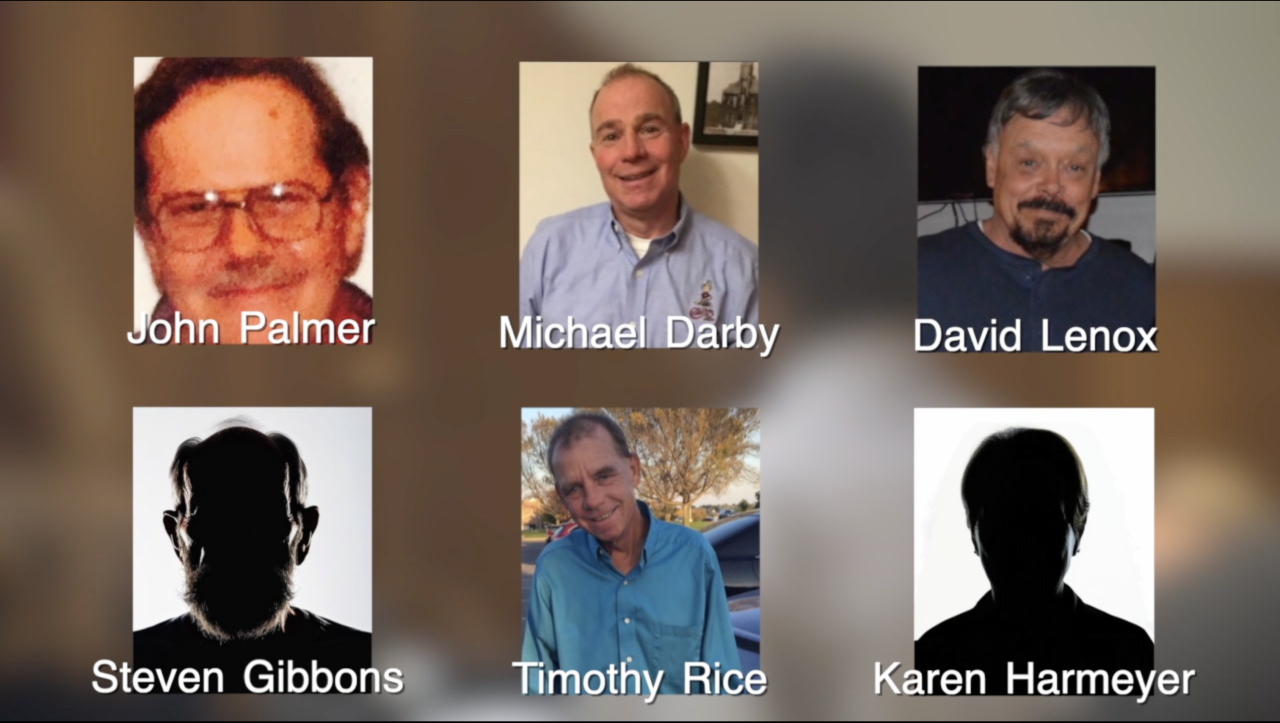
The body turned out to be 54-year-old John Palmer, a local cook who had been shot multiple times and dragged into a wooded area just off the trail.
He was found one day before what would have been his 55th birthday.
For months, it seemed to be an isolated incident.
Six months later, another man was found shot to death on Feb. 27, 2017. This time, the victim was found in the parking lot of the Willow Creek Apartments, which is easily accessible from the Indian Creek Trail.
The victim was identified as David Lenox, 66, a Vietnam War veteran who was walking his dog Snickers when he was killed.
A little over a month later, on April 4, 2017, a homeless man was found dead from multiple gunshot wounds, including one to the head.
The body of Timothy Rice, 57, was discovered under a shelter house near the trail.
On May 18, 2017, another killing happened on the trail. The victim, 65-year-old Mike Darby, died from a single gunshot to the back of the head.
The Coach’s bar owner, philanthropist and active member of the Kansas City cycling community had been out walking his two dogs — like he did every morning.
Finally, police caught a break on Aug. 13, 2017, but not before another life was claimed.
Steve "Gibby" Gibbons, 57, a husband and father of two, was fatally shot in the back of the head after departing a KCATA bus.
Security video and DNA evidence at the scene led police to Scott, then 22 years old, who admitted to routinely using the Indian Creek Trail.
He was arrested Aug. 17, 2017, two days shy of the anniversary of the first death on the trail.
Police would later attribute another death to Scott, the only one that didn't match the previous pattern of white men ages 54 to 67.
Karen Harmeyer, 65, a homeless woman, died earlier that summer after being shot in the 1200 block of Blue Ridge Boulevard in Grandview, Missouri.
Detectives speculated that because of the clothing she was wearing at the time of death, it is possible she was mistaken for being male.
Over the next seven months, Scott would find himself facing charges for each of their murders.
Scott admitted to killing Palmer and Gibbons, but said the latter was an accident, claiming the gun went off as he pulled it from his pocket, per court documents.
No possible motive was given by police, and no known connection to any of the victims has been revealed. The only comment shared by detectives was that Scott said during questioning he was mad over the death of his brother in 2015.
Iced tea and cigarette lead to arrest
As for what led to Scott's arrest, police point to surveillance video, a bottle of iced tea and a cigarette butt.
Police started looking at surveillance video from the area where Gibbons was fatally shot after getting off a KCATA bus.
Gibbons was spotted boarding a bus at 75th Street and Troost Avenue, according to court documents.
A man, who would later be identified as Scott, was seen carrying a Brisk Iced Tea bottle and boarding the bus directly behind him.
Three minutes later, the bus pulled over near 67th Street.
Gibbons got off the bus, followed by the same man, who kept a large gap between them as they continued down Troost.
During that time, the man following him appeared on camera drinking from a beverage with a screw top. The camera panned away shortly before what would later become the crime scene.
Less than a minute later, the man was again picked up on camera running away from where Gibbons' body was found.
When detectives searched the crime scene, they found a 32-ounce Brisk Iced Tea bottle with a blue screw top.
Footage from inside a nearby gas station earlier that day showed a man, who appears to be Scott, buying the same size and type of iced tea with the same type of lid.
A still from that surveillance video was shared with law enforcement.
Four days after the killing, an officer said he encountered a man who matched the description from the video. The man was on a wall, smoking a cigarette at 97th Street and Holmes Road. He identified himself as Scott.
After he left, the officer said he collected the cigarette butt and sent it to the crime lab to be processed.
It was a match with the tea bottle found at the murder scene, according to the prosecutor's office.
The DNA was also linked to a red shirt that had been found next to Palmer, the first murder victim.
During a search of Scott's home, police found a 9mm handgun that Scott reportedly admitted was used to kill Gibbons.
While Scott maintained the gun went off accidentally, he admitted to shooting Palmer's body and dragging him into the woods.
He denied killing Lenox, but he admitted to frequenting the Willow Creek Apartments to visit a friend who lived there.
Of the shell casings found near all of the bodies along the trail, investigators said the bullets matched guns and ammo linked to Scott.
Mental health delays in trial
As KSHB 41 News has extensively reported, this case has been repeatedly delayed over the years, both due to changes in judges and the defense, as well as Scott’s mental competency.
Due to Scott's diagnosed schizophrenia, he has fluctuated in and out of mental competency while in the custody of the Jackson County jail.
While the jail can't force individuals to take medications, the Missouri Department of Mental Health can. However, there has been an ongoing delay in individuals being admitted due to limited bed space, along with wait times in the six- to nine-month range.
The repeated delays in this case have been a continuous source of frustration for victims’ families.
Scott was most recently deemed competent to stand trial in July 2025.
Opening statements
During opening statements, the state asked jurors to find Scott guilty on six counts of first-degree murder and armed criminal action. Scott is pleading not guilty.
The jury was shown pictures of all six victims. An attorney for the prosecution told jurors that evidence will show the murders followed a “distinct pattern" and happened in areas well known to the defendant.
The state also made a point to mention the guns believed to be used in all of the shootings were fraudulently reported stolen by Scott, sometimes even days before the murders.
During the defense’s opening statement, Scott’s lead attorney argued only one of those guns has been recovered, claiming the evidence will not conclusively show the bullet casings found match the firearms Scott reported missing.
As part of their opening statements, both sides played portions of a video recorded during a seven-hour police interrogation with Scott.
During much of the video, Scott is looking down and mumbling. At several points, he confessed to shooting Palmer and dragging his body off the trail, as well as admitting to lying about the gun being stolen.
When questioned why, he repeatedly talked about the death of his brother, at one time saying he felt "grief" after the killings.
While being questioned about the death of Gibbons — which he said was an accident — Scott claimed at one point the man “called him the N-word.” The detective then asked Scott, “Did you light him up then, did it feel good?”
While Scott doesn’t definitively respond, the detective can be heard saying, “You’re smiling.”
The defense suggested his statements at the time were not a true reflection, but the result of a detective “pressing pretty hard.“ The defense also brought up what they suggest is a lack of follow-through by police when it came to determining Scott’s mental health at the time of the interrogation.
During the video, he told the detective he had been evaluated for mental health as part of his probation for a previous shoplifting charge. He said he was diagnosed as bipolar with depression.
The defense suggested Scott had already been diagnosed with schizophrenia, and if police had looked into the prior mental health evaluation, they would have known that.
Mental health has certainly been touched upon in the hearings leading up to this trial, and the defense appears poised to argue over the validity of the evidence.
KSHB 41's Caitlin Knute was in court Thursday and will continue to follow the duration of the trial.
—