

KSHB 41 reporter Olivia Acree covers portions of Johnson County, Kansas, including Olathe and Lenexa. Share your story idea with Olivia.
—
If the motto to live by is to get 1 hour of movement a day, the Parkinson's community in Kansas City is exceeding it.
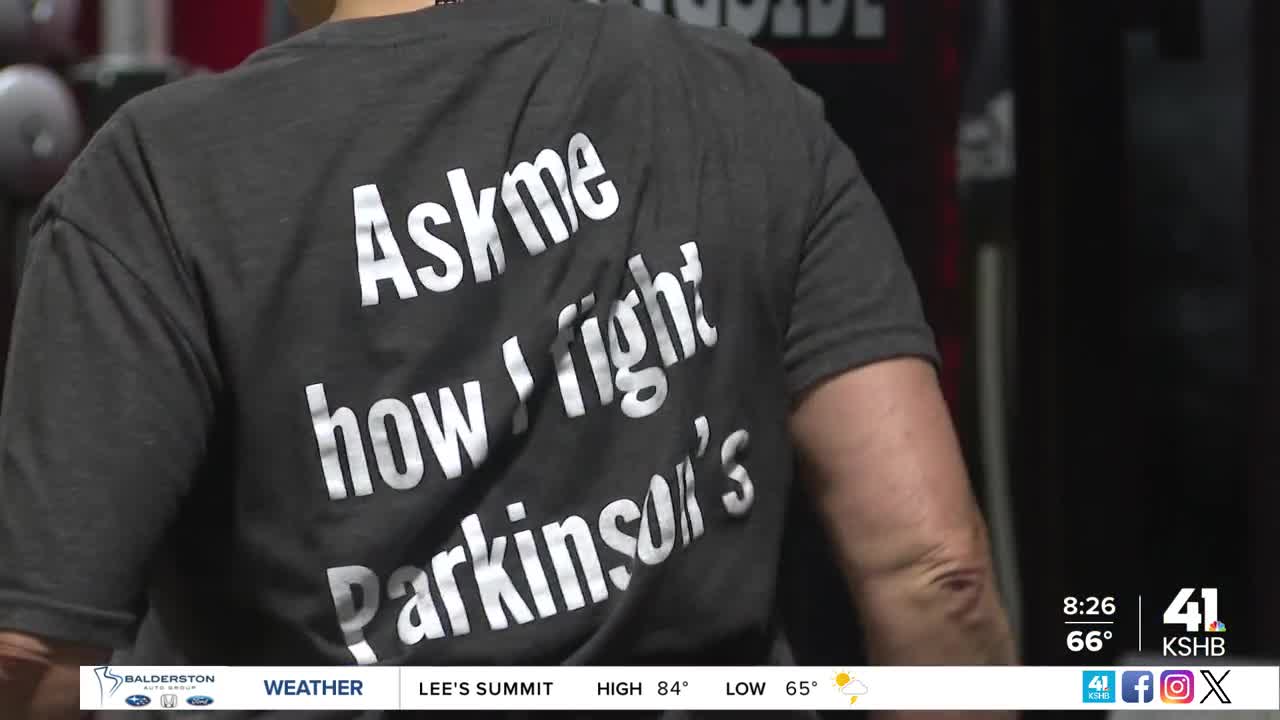
Bob Zipse has been fighting Parkinson's for 10 years. He said the diagnosis hit him hard.
"I was super depressed. I mean, I was in a chair. Did you want to move? Look around, just horrible. Because there's no resources. Where do I go with the time?"
Zipse said the disease can be an isolating experience.

"Parkinson's, I say, is a very lonely, lonely disease. Either people don't want to deal with you, or you're embarrassing."
He found the Parkinson's Exercise and Wellness Center at his lowest point. Now, he sees people around him pushing past their limits.
"You see people out here, they're in the mid-70s, they're doing push-ups, sit-ups, lifting weights. I mean, it's amazing, really," Zipse said. "In here, we're all the same.”
Sarissa Curry founded the center after seeing the power of healing through exercise and recognizing that diagnosis rates were increasing. An aging population and younger diagnoses are among the biggest factors driving that trend.
Kansas consistently ranks as having one of the highest Parkinson's disease diagnoses and mortality rates in the United States, second only to Nebraska. According to the Parkinson's Foundation, an estimated 20,000 people in the Kansas City metro alone are living with the disease.
"You see your neurologist once every six months to a year, and you see a physical therapist maybe a couple of months out of the year. Community-based programs are here every day to support this community," Curry said.
Curry said the warning signs of rising Parkinson's rates have been visible for years.
"They have been predicting this increase in Parkinson's for many years. They were able to see the writing on the wall, they were able to see how the population was aging, and they knew that this was coming. We paid attention."
She expanded the center to serve as an all-encompassing resource for people like Zipse.

"I'd hate to wager what I would have been like. Life would have stopped for me, I think. This at least gives me hope, gives me some work towards and see some benefit of it,” Zipse said.
The PEWC will host a ribbon cutting on Wednesday, June 3, at 3:30 p.m. The community is invited to attend to learn more about the center's services and the disease as incidence rates continue to rise each year.
This story was reported on-air by a journalist and has been converted to this platform with the assistance of AI. Our editorial team verifies all reporting on all platforms for fairness and accuracy.
—