

OVERLAND PARK, Kan. — KSHB 41 reporter Rachel Henderson covers neighborhoods in Wyandotte and Leavenworth counties. Share your story idea with Rachel.
—
After a Kansas City, Kansas police officer shot and killed Jesse West earlier this month, I set out to investigate how police departments on the Kansas side of Kansas City approach mental health crises. My first stop was Overland Park.
The Overland Park Crisis Action Team — known as OPCAT — officially came together in late 2021. It includes five Crisis Intervention Training (CIT) specialists, five co-responders and one team lead: Sgt. Stewart Brought.

Brought was tasked with building the unit from the ground up, drawing on his experience as a police negotiator.
"In a perfect world, no one ever knows that my unit exists. So we go out, we deal with a crisis, we give somebody the resources they need, and we move on to the next call for service. That's how I measure success for this unit," Brought said.
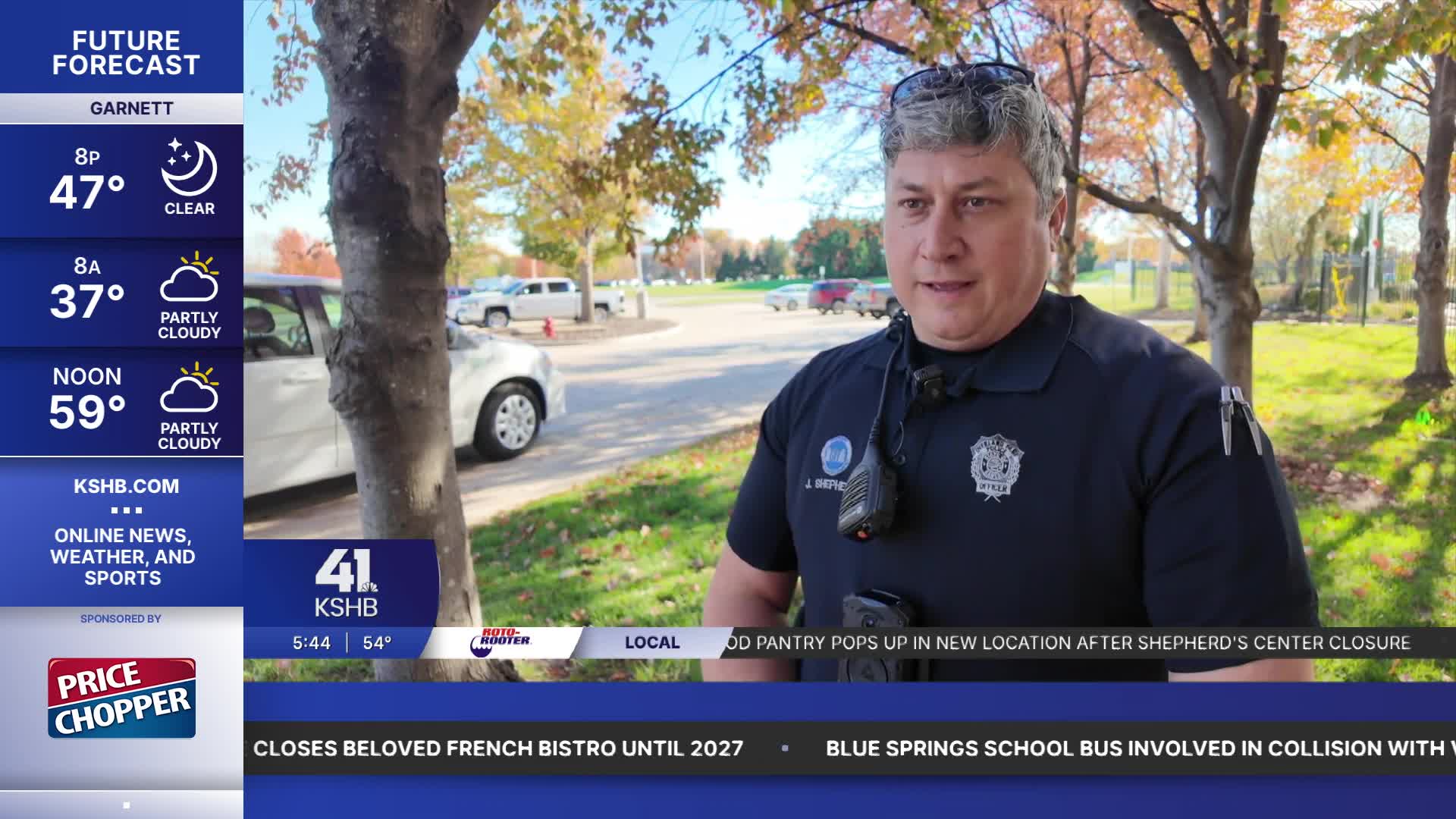
CIT Specialist Justin Shepherd has watched the program grow since joining the department's behavioral health division in 2017, when it was just him and one co-responder.
There's even a K9 member of the team named Haven.

"One thing I've learned over the years when law enforcement becomes involved, it has an impact one way or the other. Because of that, there's been a need for a certain level of support," Shepherd said.
The co-responders embedded with OPCAT are master's-level clinicians employed by the Johnson County Mental Health Center and trained to work alongside officers during active crises. The team covers the city Sunday through Saturday, from about 7 a.m. until 2 a.m. When no co-responder is available, officers can reach a 24/7 crisis line staffed by the center.
"More would be helpful, but we can do a lot with what we have," Shepherd said.

Shepherd has watched the volume of mental health-related calls increase throughout his career — a trend he attributes to greater public awareness and self-identification.
"Because of that self-identification, more calls have that focus related to it. It's not just somebody who's having a bad day, it's somebody who might be in a mental health crisis," Shepherd said.
The need is significant. In 2025, the co-responder program across Johnson County recorded nearly 30,000 interventions. Jessica Murphy is the Deputy Division Director of Emergency Services at the Johnson County Mental Health Center.
"Speaking of Overland Park in particular, they have our highest call load, so they are going to go out to a mental health call... every single day, probably multiple throughout the day," Murphy said.
Murphy's agency has partnered with Johnson County law enforcement since 2011. Today, it oversees seven co-responder programs across the county, with 25 total co-responder positions.
The program's goals include keeping people in their communities and out of emergency rooms and the criminal justice system when possible.
Murphy's center also operates a 24/7 mobile crisis response team staffed entirely by civilians, designed for lower-level calls where a law enforcement presence may not be needed.
For Murphy, the work doesn't stop when a crisis call ends.
"What we know is the crisis doesn't always end on that first call," Murphy said.
78% of the Overland Park Police Department — about 200 sworn officers — has completed CIT training through the Memphis model, a 40-hour program that includes scenario-based exercises and cross-agency collaboration. Mental health training is also part of an officer's first day at the academy.
An OPPD member provided an update for the city on the department’s staffing during a public safety meeting on November 11.
For Murphy, there is one quality she simply cannot teach.

"I personally always say that I can't train someone to have compassion, but we can train them to do the job," Murphy said.
Brought takes a similar approach when selecting officers for OPCAT. No one is assigned to the unit — officers must apply, shadow the team and interview for a spot.
"People always think they can come to this unit, 'Oh I can talk to anybody,' well I don't need somebody that can talk to anybody, I need somebody that can listen to anybody. I need somebody that can actually listen to what they're saying and offer the resources they actually need in that moment of crisis," Brought said.
OPCAT continues to evolve. The unit now includes specialists focused on elderly populations, youth and substance use disorder. The team has also launched a decal program, placing information on the front of residences so officers can review key details before approaching a call.
For Brought, one of the clearest signals that OPCAT is making a difference comes not from data, but from the police radio.
"That's probably the number one thing you hear on the radio from our officers, 'Is OPCAT available?'" Brought said.
I'm planning to head to Topeka and Lawrence later this week to see how those cities approach crisis intervention.
This story was reported on-air by a journalist and has been converted to this platform with the assistance of AI. Our editorial team verifies all reporting on all platforms for fairness and accuracy.
—