

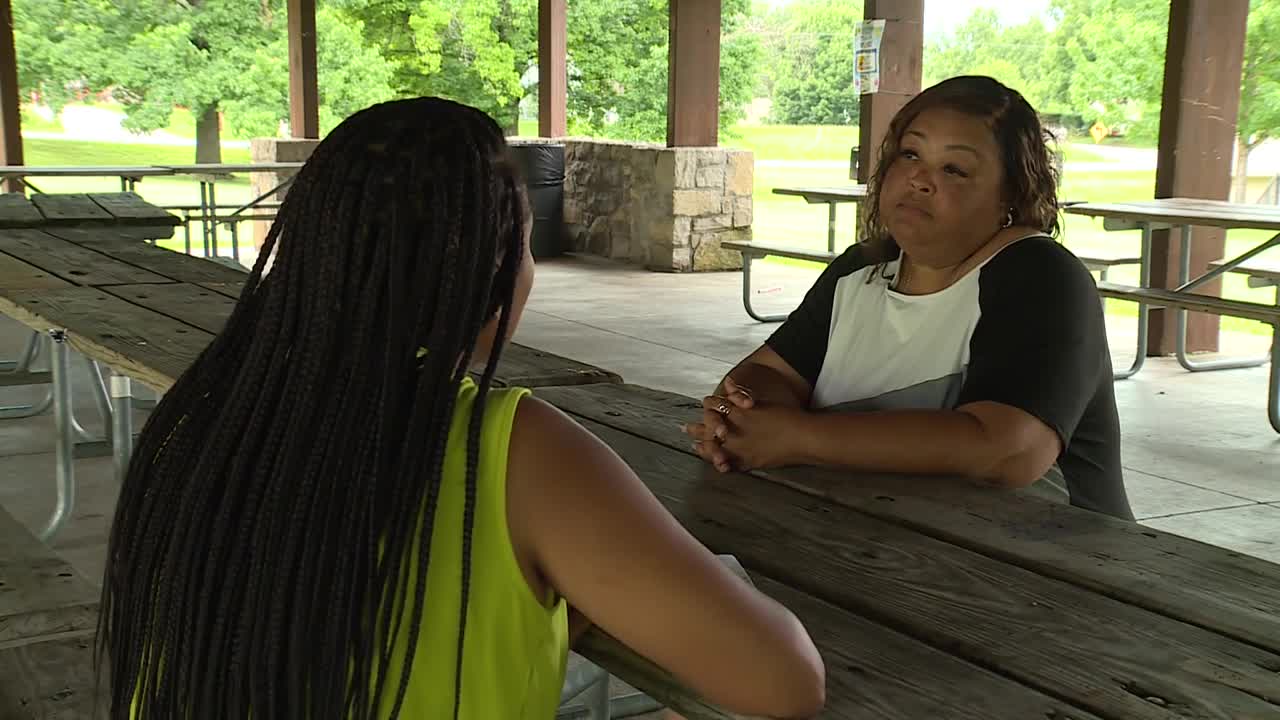



KANSAS CITY, Kan. — KSHB 41 reporter Rachel Henderson covers neighborhoods in Wyandotte and Leavenworth counties. Share your story idea with Rachel.
—
Bruce Charles Thomas, 24, was shot and killed by a Kansas City, Kansas, police officer on July 1 after he came at officers with a knife.
His mother says she sought help for him before the shooting and is now demanding answers.
Angel Thomas was on the road to Miami when her son called to tell her Bruce was dead.
A detective called shortly after.
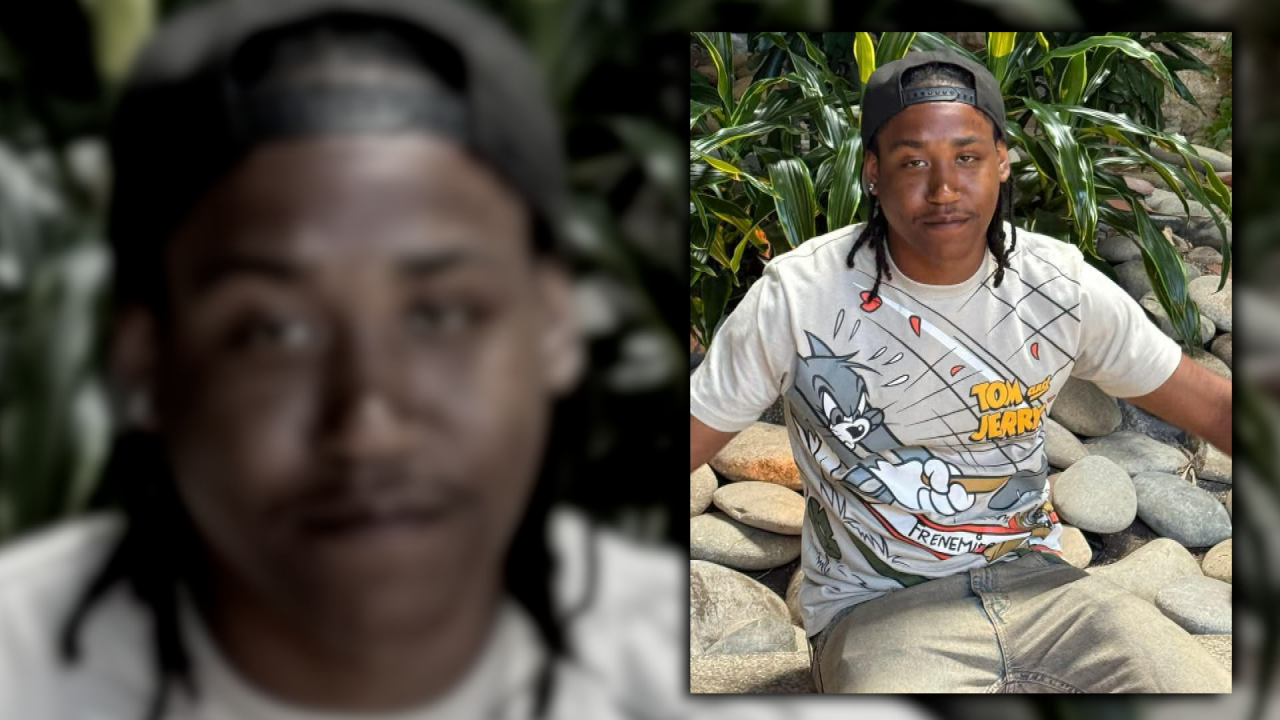
According to the Kansas Bureau of Investigation, police were called to the scene after a family member said Thomas was threatening them.
The KBI report said Thomas came at officers with a knife, and one officer shot him.
“[I] never would think my son would lose his life over this incident, and I still have questions, and I need answers," Angel Thomas said.
Background
Angel Thomas said Bruce had struggled with bipolar disorder and schizophrenia for about three years before his death, saying the conditions came on later in life.
"He is just this lovable person one minute, next minute, it changes to where he'll think the whole world is against him,” Thomas said. “Where we're not, we're all in this together to love him.”
Before the shooting
In the days before the shooting, Angel Thomas said she called the 988 Crisis Line after she saw Bruce beginning to have an episode.
She said 988 told her to call the non-emergency number.
Two officers responded, spoke with Bruce, but he refused to go for an evaluation.
Angel Thomas said an officer told her she could go to court to obtain a court order to have him committed.
"That's still not helping the situation when I see that that's gonna take time to get a court order,” Thomas said. “I already seen something was getting ready to happen.”
She said she had called the crisis line before, but the situation had never been that extreme.

She said she had also taken Bruce to a local mental health center, but felt the care fell short.
Angel Thomas said Bruce refused to acknowledge he needed help.
"He said, 'I don't have a problem.' He said we had the problem. That's how he sees it," Angel Thomas said.
She said she believed he needed medication to help manage his thoughts, and she believes the system failed her family at multiple points.
"If a family member is telling you that my son or my daughter needs help, they should go ahead and try to seek the help for that person, instead of ending someone's life," Angel Thomas said.
Angel's personal experience
Angel Thomas works in the medical field with people who have mental illnesses.
She said that experience shapes how she sees the response her son received.
"They need more people that have a heart, really have a heart for the people they're taking care of,” Thomas said. “I’m in the medical field. I deal with people like this. I see them as my family. If I see them hurting themselves, I can't let that happen.”
She also said the family member who witnessed the shooting, Bruce’s brother, has not received any outreach for counseling.
"For a family to go through this, they're not considering the family member that was there, that seen the whole thing happen. They're not reaching out to see if that person needs counseling," Angel Thomas said. "I know he needs some kind of counseling because it's gotta be hard on him because this happened while he was there.”
A mother's questions
Thomas said she has sent repeated messages to authorities seeking information and has not heard back.
"I sent text after text, I haven't heard anything," Angel Thomas said.
She questioned why lethal force was the first response when her son came at officers with a knife.
"Why was the first thing the officer thought was to shoot him?" Angel Thomas said. "It's him trying to tell them to leave them alone. It's crying out for help.”
Expert insight
Ernest Stevens, managing director of behavioral health at the Council of State Governments Justice Center and a former law enforcement officer with 30 years of experience in San Antonio, said the dynamic between a person in crisis and an armed officer is complicated.

"Sometimes that knife is like their microphone,” Stevens said. “Like, they get to finally be heard for a moment. And an officer sees a weapon, and that's an immediate threat to life.”
Stevens said once a weapon is present, Crisis Intervention Team training — which is built around de-escalation — becomes limited in what it can offer.
"The most difficult part about this is that when you encounter somebody with a weapon, CIT training is very limited at that point because it is based on de-escalation," Stevens said. "Whenever there's a weapon that's being produced, you have very little options at that point as an officer.”
Stevens said communication skills can still make a difference, but acknowledged most officers are not naturally inclined toward them.
"I think knowing how to properly communicate with that person can, a lot of times, solve that issue," Stevens said. "We know that officers are either good communicators or not, and most of them are not by choice because they have so many tools in their belt to try to flex authority to take control of a situation.”
Behavioral health approaches
Stevens said CIT training, which began in Memphis after a shooting in the 1980s, is typically a 40-hour course.
He said about 90% of law enforcement agencies across the U.S. have 50 officers or fewer, making it difficult to free up staff for training.
"It's very difficult to free up manpower or workforce at all to attend a 40-hour training, especially when agencies and departments are struggling to keep staffed," Stevens said. "You can't deny officers this type of training because the calls that they're going to respond to, they don't have a choice what calls they respond to.”
A KCKPD spokesperson shared the frequency of their training in our previous coverage, where we also spoke to one of the family's neighbors.
Stevens said dispatcher training in CIT is also important, and that some agencies can access previous call history at a location before responding.
He said the more information officers have before arriving, the better.
Stevens said 988 was built for anonymity and is better suited for resources, suicide prevention, and information — not every crisis.
"988 is not always going to be the right call, especially when somebody is very aggressive or really disconnected from reality," Stevens said.
He said involuntary commitment laws vary by state and are set by state policymakers.
In Texas, he said, a judge, a law enforcement officer, or a parent or guardian can commit someone — but a doctor or licensed clinical social worker cannot.
He said the criteria differ significantly from state to state.
"It is state-specific,” Stevens said. “I think that's something state policymakers need to look at to find out what criteria exist for an involuntary commitment.”
A work in progress
Stevens said community responder programs — which send non-law-enforcement personnel to certain crisis calls — are growing nationally, but do not apply to situations involving a weapon.
He pointed to Denver's model as an example.
He also said people in case management are far less likely to become involved in the criminal justice system and called for better programs to identify gaps in care for individuals who repeatedly go into crisis.
"You gotta remember, every time an officer goes to one of these crisis calls, there will always be a gun involved: the officer's gun,” Stevens said. “So you have to take that into account when that's your only response.”
He spoke to how expensive it can be to fund programs targeting these approaches, but said they should still be prioritized.
"You can put as high a price tag as you want on it. It will never be as high as a human life," Stevens said.
The immediate future
Angel Thomas said she wants the system to change — and she wants her son remembered for who he was.
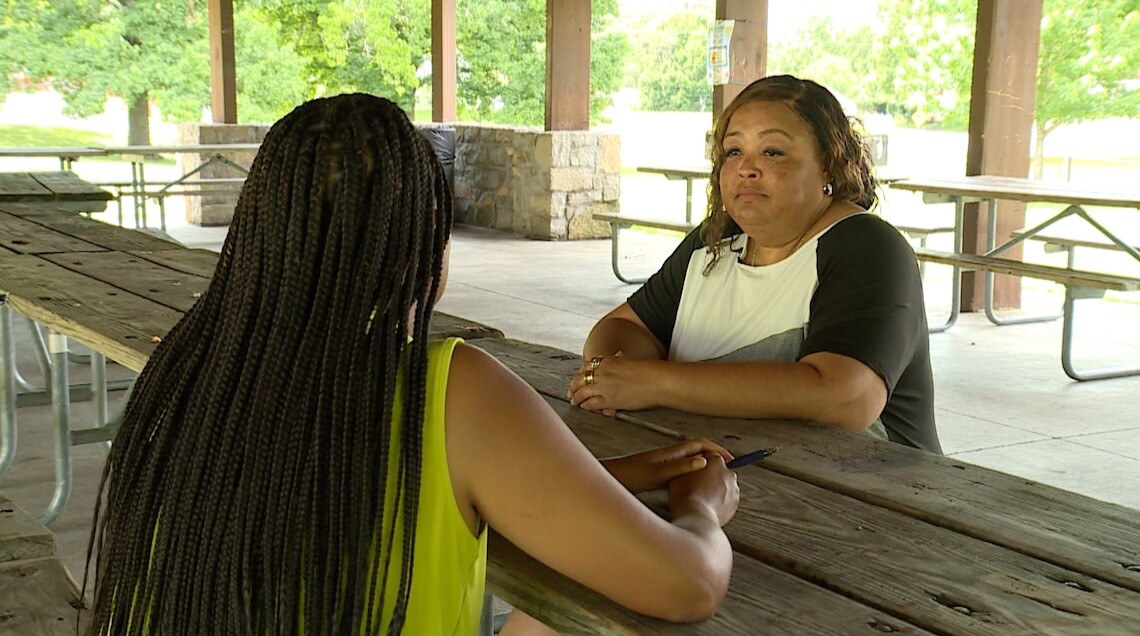
"He had so much ahead of him if we could have just got his mental health on track because he loved helping people," Angel Thomas said. "He felt misunderstood. He felt like no one was listening to him. But we was listening, I was hearing, and I was trying.”
Thomas created a GoFundMe in her son's honor.
This story was reported on-air by a journalist and has been converted to this platform with the assistance of AI. Our editorial team verifies all reporting on all platforms for fairness and accuracy.
—

![092126_KSHB_WX_480x360[61].jpg](https://ewscripps.brightspotcdn.com/dims4/default/79e7fad/2147483647/strip/true/crop/480x360+0+0/resize/960x720!/format/webp/quality/90/?url=http%3A%2F%2Fewscripps-brightspot.s3.amazonaws.com%2F6f%2F6d%2Fa3758caf4c0984b0ecf100f620d1%2F092126-kshb-wx-480x36061.jpg)