



KANSAS CITY, Mo. — KSHB 41 reporter Tod Palmer covers sports business and eastern Jackson County, including Independence. Share your story idea with Tod.
—
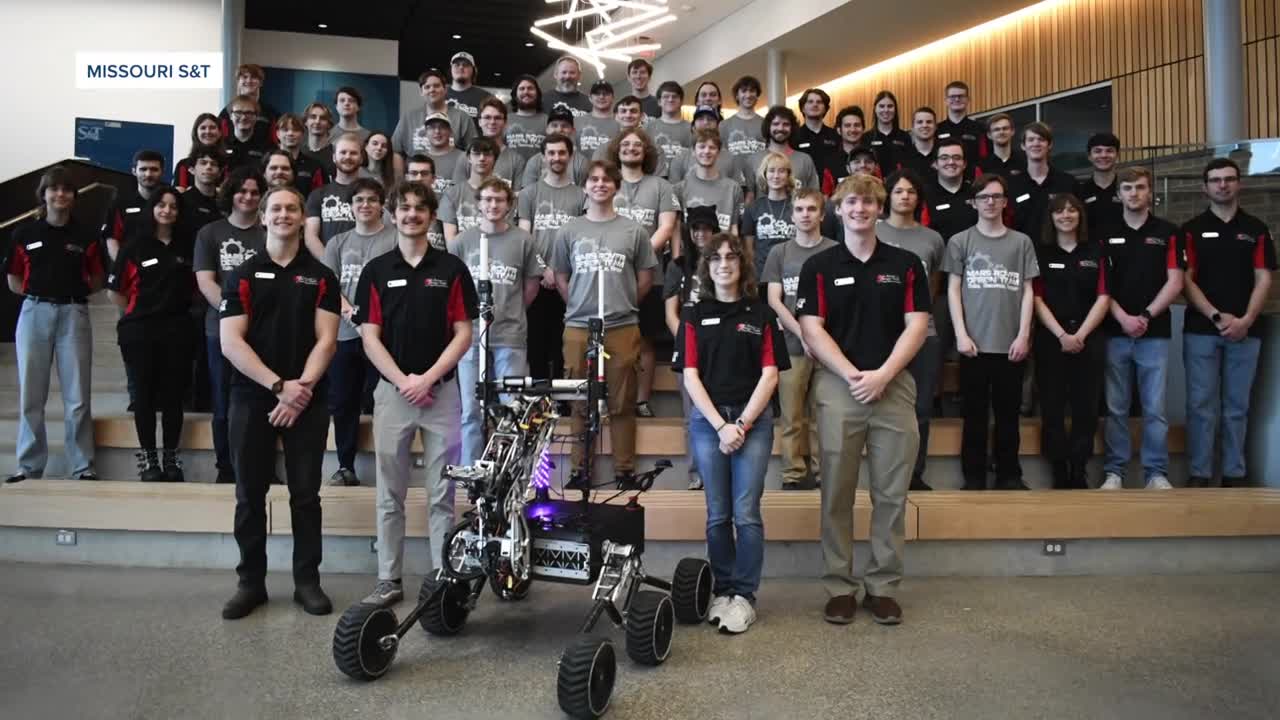
Missouri S&T’s Mars Rover Design Team won the University Rover Challenge, an annual competition at the Mars Desert Research Station in Hanksville, Utah, for the second consecutive year.
The Mars Rover Design Team beat out 37 other teams from 11 counties to claim the title in late May. It was Missouri S&T’s third title overall.
The team's rover, Athena, had to travel long distances, take samples, perform scientific analysis, drive autonomously, navigate unknown terrain, make repairs, and operate a drone to compete in the challenge.
"I didn't really expect it,” the team’s newly anointed CEO Sofia Tripp said. “I was more there to see the rover perform, to see us perform as a team, and it was — it was surreal.”
The Mars Rover Design Team is one of more than three dozen design-build teams at Missouri S&T and serves as a hands-on learning environment for students that goes beyond what the classroom can offer.
"It definitely gives you tools, a lot of tools that you just wouldn't get in the classroom," the team’s new Chief Administrative Officer Adam Klassen said.
"The classroom is great for teaching you kind of the math behind it... but rover is an amazing experience to kind of get that hands-on feeling of like, ‘Oh, this is the reason,’” new CFO Dominic Salvo said in agreement.
Klassen said the competition evolves each year “to kind of keep it in line with what NASA is also doing."
Missouri S&T Biological Sciences professor Melanie Mormille, one of the team's faculty sponsors, said she tried to temper expectations for the 2026 team despite last year’s win.
"Me and the other advisors were warning the team, 'Now, don't get, you know, your hopes up too much because this just doesn't happen,'” she said. “Then, for them to actually do it, it was like, ‘This is amazing, this is great.’”
Beyond the engineering, team members said the relationships they build are just as important as the rover itself.
"We always say that people come for the rover, stay for the people," Salvo said.
"I feel like I am around some of the smartest people that I've ever known," Tripp added. "Also, like around some of the funniest and goofiest people, but also just I didn't expect from the team to get the support system that I have today. That's something that I really value about the team.”
Some team members spend 40 hours a week working on the rover above and beyond their classwork, but Klassen said the team's culture of curiosity and continuous improvement sets it apart.
“Rover is the kind of club where you'll be having a party outside of rover, but people will still be talking about technical things on the rover,” he said. “They'll still be nerding out about stuff, and I really enjoy that environment where people really strive to not just make something, but also discuss and learn how you could do this better.”
Salvo appreciates that camaraderie too.
"We really kind of pride ourselves on the culture,” Salvo said. “So, we're not building rovers — we're building engineers.”
This story was reported on-air by a journalist and has been converted to this platform with the assistance of AI. Our editorial team verifies all reporting on all platforms for fairness and accuracy.
—

![092126_KSHB_WX_480x360[61].jpg](https://ewscripps.brightspotcdn.com/dims4/default/79e7fad/2147483647/strip/true/crop/480x360+0+0/resize/960x720!/format/webp/quality/90/?url=http%3A%2F%2Fewscripps-brightspot.s3.amazonaws.com%2F6f%2F6d%2Fa3758caf4c0984b0ecf100f620d1%2F092126-kshb-wx-480x36061.jpg)