



GRAIN VALLEY, Mo. — KSHB 41 reporter Tod Palmer covers sports business and eastern Jackson County, including Independence. Share your story idea with Tod.
—
Baseball card collecting has changed a lot in the last 30 years, but the hobby is still largely about the thrill of the hunt.
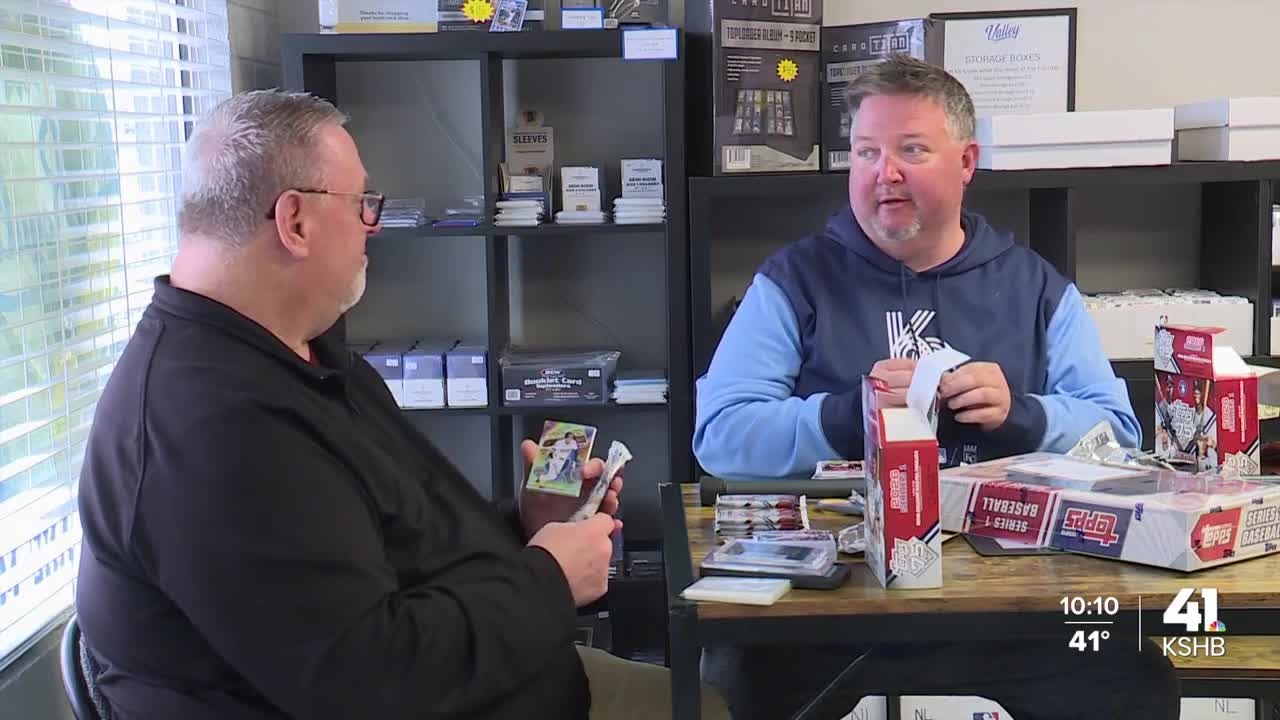
That made it thrilling Friday when Camden Simpson, a sixth grader in Grain Valley, pulled two Jacob Misiorowski cards while opening packs at Valley Sports Cards.
Misiorowski, a 2020 Grain Valley graduate, is a hard-throwing All-Star right-hander for the Milwaukee Brewers. The No. 63 overall pick in the 2023 MLB First-Year Player Draft struck out 11 on Thursday in a record-breaking Opening Day performance.
“Sometimes you can pull your favorite players and it's cool to see that, because it can make you feel closer to the player,” Camden said.
He listed Misiorowski as his fifth favorite big-leaguer behind reigning NL MVP and Los Angeles Dodgers two-way star Shohei Ohtani, reigning World Series MVP and fellow Dodgers ace Yoshinobu Yamamoto, reigning AL MVP and New York Yankees slugger Aaron Judge, and Royals shortstop Bobby Witt Jr.
“Being here in Grain Valley and pulling a graduate from Grain Valley on a card, not a lot of people can do that,” Camden’s dad, Jared Simpson, said.
John Unrein and with his wife, Cory, opened Valley Sports Cards, 203 S. Main St., Suite A in Grain Valley, on March 28, 2024. The couple’s shop will celebrate its two-year anniversary Saturday.
After card-collecting’s heyday in the 1980s and ’90s, the 1994 strike and an oversaturation of baseball cards essentially put ‘the hobby” on hiatus, but it has roared back in popularity in recent years.
Unrein credited the pandemic for the renewed interest.
“Maybe one of the few good things that came out of COVID is people went back into their collections,” he said. “People started collecting again.”
Trading card companies also reinvented their offerings, leaning into rare and exclusive cards often with jersey patches and/or autographs in addition to the usual photo card with stats on the back.
“You can get a variety of products at very different price points — anywhere from retail to hobby odds,” Unrein said. “Hobby, you have better odds of pulling something significant out of it, but you also pay more for it.”
Some packs cost thousands of dollars, making the hobby more of an investment than three decades ago and before.
“We could go get a box of cards for probably $10 or $20, and now you see boxes of cards and cases for $4,000, $5,000, $10,000, so it's changed a lot,” Jared said. “Just the variety, the options, is unbelievable.”
It is not strictly a hobby for kids anymore, even some professional baseball players have caught the bug.
“I have a few wives mad at me with the teammates I've brought down the rabbit hole with me,” Royals southpaw reliever Matt Strahm said.
Strahm — who hosts “The Card Life,” a TV show about the hobby — collected baseball cards as a kid growing up in Fargo, North Dakota.
“Every time mom would go shopping, dad would take my brother and I down to, it was called Big Nick's Card Shop at the time,” Strahm said.
As he got more serious about baseball in high school and college at Neosho County Community College in Chanute, Kansas, he stopped collecting cards.
But Strahm started collecting again while living with his brother, Ben, after he was drafted by the San Francisco Giants.
“He is an entrepreneur,” Strahm said, “He flips — buys and sells — flips things, and he was doing that with cards. One day, I stopped and bought a box, opened it up and I hit a pretty nice (Ronald) Acuna (Jr.) card. I just felt like a 12-year-old again.”
Strahm famously collects rookie cards of players who hit a home run off him, and he owns about 30 of his own one-of-one trading cards.
There is also a practical aspect to card collecting for Strahm, who broke into the majors in 2016 with Kansas City before being traded to San Diego.
“My first year here, guys gave me jerseys, bats, gloves — signed memorabilia,” he said. “After my first year, I had like Rubbermaids and I'm like, ‘How will I ever display this?’ So, then I transitioned. I collect cards with my teammates. I mean, you could put 1,000 cards on a wall. It's hard to hang up 100 jerseys.”
While collecting cards has changed, the basics remain unchanged.
“The hunt is always attractive,” Unrein said. “People want something that is unique, something that they can brag about, something they can be proud of.”
Gone are the days of kids sitting on porches, opening packs of cards and swapping them while chewing stale bubble gum, but the community still exists.
“The porch happens digitally somewhat — through TikTok, through Facebook, through Instagram,” Unrein said.
So does the connection the hobby creates.
“It's generational,” Unrein said. “That's one of the most rewarding things — to have a father, son or a parent, kid sharing across generations.”
Jared collected cards as a kid, so he is thrilled to be into collecting again with Camden and Camden's sister.
“They do their chores, they get good grades, we swing by the card shop and buy a mystery card that we open,” Jared said. “Now, it's turned into a full-blown hobby... Just seeing them open the packs and get that smile is what makes the $30, $40, $50 bucks you spend worth it.”
—

![092126_KSHB_WX_480x360[61].jpg](https://ewscripps.brightspotcdn.com/dims4/default/79e7fad/2147483647/strip/true/crop/480x360+0+0/resize/960x720!/format/webp/quality/90/?url=http%3A%2F%2Fewscripps-brightspot.s3.amazonaws.com%2F6f%2F6d%2Fa3758caf4c0984b0ecf100f620d1%2F092126-kshb-wx-480x36061.jpg)