

PAOLA, Kan. — KSHB 41 reporter Ryan Gamboa covers Miami County in Kansas and Cass County in Missouri. He also covers agricultural topics. Share your story idea with Ryan.
—
Some Kansas pharmacies will close Wednesday to advocate for legislation aimed at increasing transparency in prescription drug pricing and addressing what they call unfair practices by pharmacy benefit managers.
The statewide closure is part of an effort to support Senate Bill 360, known as the Kansas Consumer Prescription Protection and Accountability Act.

The comprehensive legislation would establish new regulations for pharmacy benefit managers and require greater transparency in prescription drug pricing.
Pharmacists say they're being forced to sell medications at a loss because of reimbursement practices by pharmacy benefit managers, or PBM's.
Nate Rocker, former owner of Rockers Pharmacy in Paola, Kan., closed his pharmacy in 2024 after what he describes as unsustainable business conditions.

"40% of what we dispensed in 2024 was below what it cost just to purchase the pills," Rocker said. "70% of what we dispensed in 2024 was below what it cost to do business."
The problem goes beyond reimbursement rates.
Rocker says PBM's have access to detailed data about every transaction, patient, and pricing structure at independent pharmacies, which they then use to steer patients toward retail pharmacies they own or mail-order facilities.
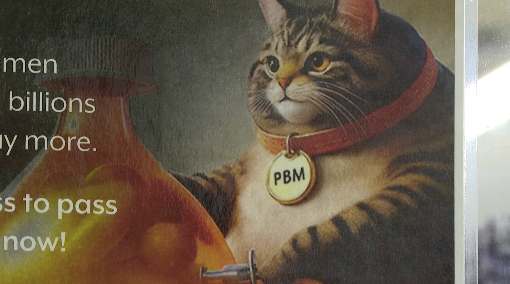
He compares the situation to forcing a local plumber to share their customer list and pricing with competing plumbers.
"If the plumber, in any small town, imagine you had to send your patient list to your competing plumber, let 'em know exactly who you were working with, exactly what jobs you were doing for them and what your pricing structure is and see how that works," Rocker said.
The financial impact was devastating.
Rocker said that four out of 10 prescriptions his pharmacy filled were priced below the cost of purchasing the medication alone, not including bottles, labeling, transmission fees, service, or employee costs.

"You can't ask a business owner to do 10 jobs and hope to make enough on three to finance the seven other jobs that they do," Rocker said.
Senate Bill 360 would address many of these concerns through several key provisions.
The legislation would require PBM's to reimburse pharmacies at least the national average drug acquisition cost plus a professional dispensing fee of at least $10.50.
It would also prohibit PBM's from reimbursing their own affiliated pharmacies more than independent pharmacies for the same medications.

The bill mandates that PBM's charge health plans the same price they pay pharmacies for prescription drugs, eliminating the practice of keeping the difference as profit.
Additionally, it requires that at least 100% of all rebates received from drug manufacturers be passed on to consumers at the point of sale to reduce their out-of-pocket costs.
Under the proposed legislation, PBM's would be required to file quarterly reports detailing drugs reimbursed at 10% above and below the national average drug acquisition cost. That would include whether the dispensing pharmacy was affiliated with the PBM.
These reports would be made publicly available on PBM websites.

The bill also establishes strict audit procedures, requiring auditing entities to provide 14 days notice before conducting pharmacy audits and limiting audits to no more than 250 prescriptions covering a period of no more than 24 months.
Rocker has since become a beef producer, trading his white coat for farm work.
"Cows might run from ya and kick ya once in a while, but they never try to cheat you," Rocker said.
Pharmacy benefit managers are multi-billion dollar companies like CVS Caremark and United Healthcare that play a large role in determining medication prices.

Will Anderson with the Kansas Pharmacy Association explains how the system works using Eliquis, a common blood thinner that costs about $600.
"PBM's will routinely reimburse us about $550, meaning that every time we fill the script, we're going to lose $50, just on the cost of the medication," Anderson said.
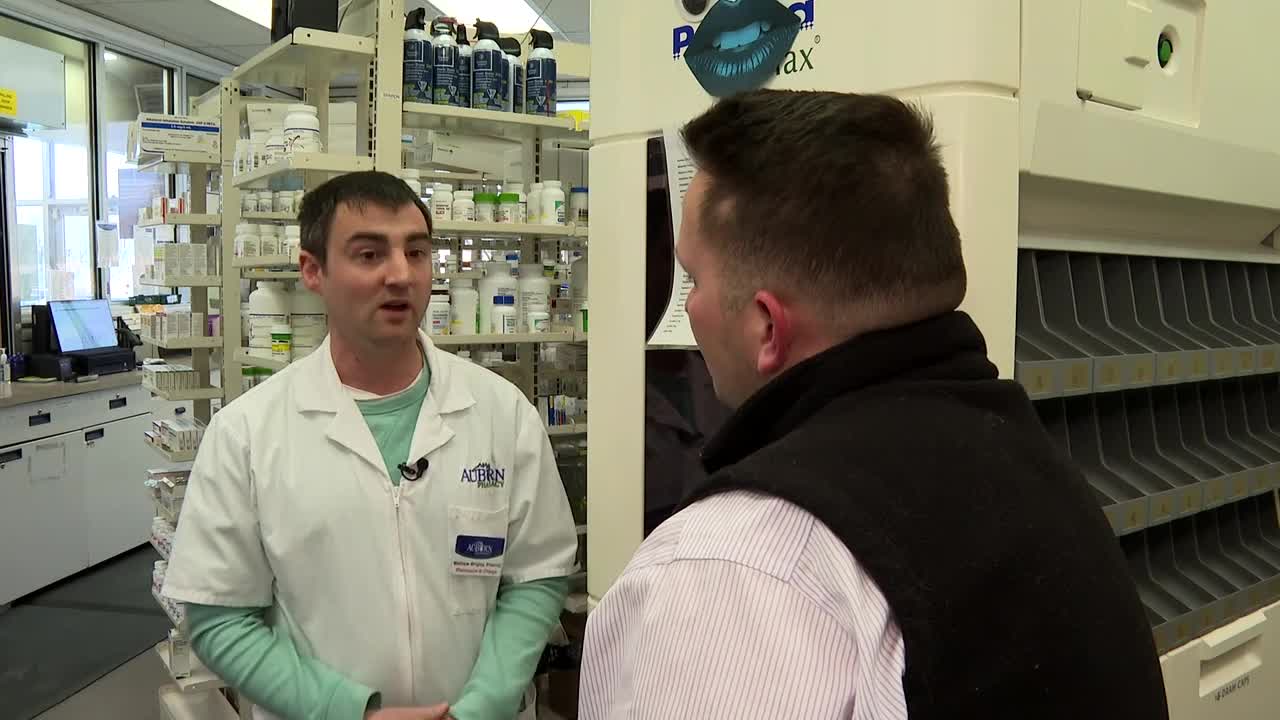
Matt Wrigley, the pharmacist in charge at AuBurn Pharmacy in Paola, is among those closing Wednesday to head to Topeka for the advocacy effort.
His pharmacy fills five to 10 prescriptions daily for medications like Eliquis.
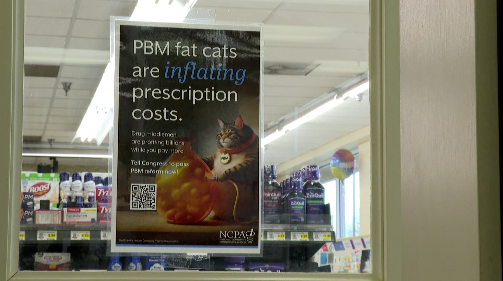
The proposed Senate bill would require transparency in how much PBM's charge insurance companies versus how much they reimburse pharmacies.
"What we want is transparency of how much they're charging the insurance and how much they're reimbursing the pharmacy. This Senate bill provides transparency and also fairness throughout all the pharmacies of what we are getting reimbursed," Wrigley said.
He also said that "Pharmacy Benefit Mangers will sometimes reimburse certain pharmacies more than others, causing some pharmacies to unfortunately close."
The middleman system puts stress on both urban and rural pharmacies.
Over 100 Kansas pharmacies have closed in the last decade, with 16 closures occurring last year alone, according to KPhA.

The closures have broader implications for healthcare access, particularly in rural communities where pharmacies may be the only healthcare provider available.
"If we lose small town pharmacies, we will lose access to quality healthcare," Rocker said. "In some communities, the pharmacy is the only healthcare provider. If we put those people out business, because we let a company out of St. Louis, Minneapolis, or Rhode Island to continue to steal from both consumers and businesses that are providing healthcare and employers and their health plans, we've lost more than just a business, we lost a resource."
Rocker says he never viewed other local pharmacies as competitors, believing there was enough business for everyone.

Instead, he saw PBM's as the real competition.
"The very middleman that got all the claims data, and every single transaction, that knew every single person I was trying to provide service for, and what we were trying to do to them," Rocker said.
Senate Bill 360 would also establish penalties for PBM's that violate the new regulations, with fines ranging from $1,000 to $100,000, depending on the severity and knowledge of the violation.
The legislation requires PBM's to obtain licenses from the Kansas Insurance Commissioner and submit to regular examinations.

The pharmacists hope their advocacy efforts will lead to changes that could ultimately help lower prescription prices for consumers.
"We shouldn't have to close healthcare for a day to convince legislators to do what's right," Rocker added.
For more information on Wednesday's meeting at the Kansas State Capitol, click here.
KSHB 41 reached out to PCMA, Pharmaceutical Care Management Association, a group opposing the legislation, for comment and did not receive a response.
KSHB 41 also reached out to SB 360's sponsor, Sen. Tim Shallenburger for comment and also did not hear back.
This story was reported on-air by a journalist and has been converted to this platform with the assistance of AI. Our editorial team verifies all reporting on all platforms for fairness and accuracy.
—