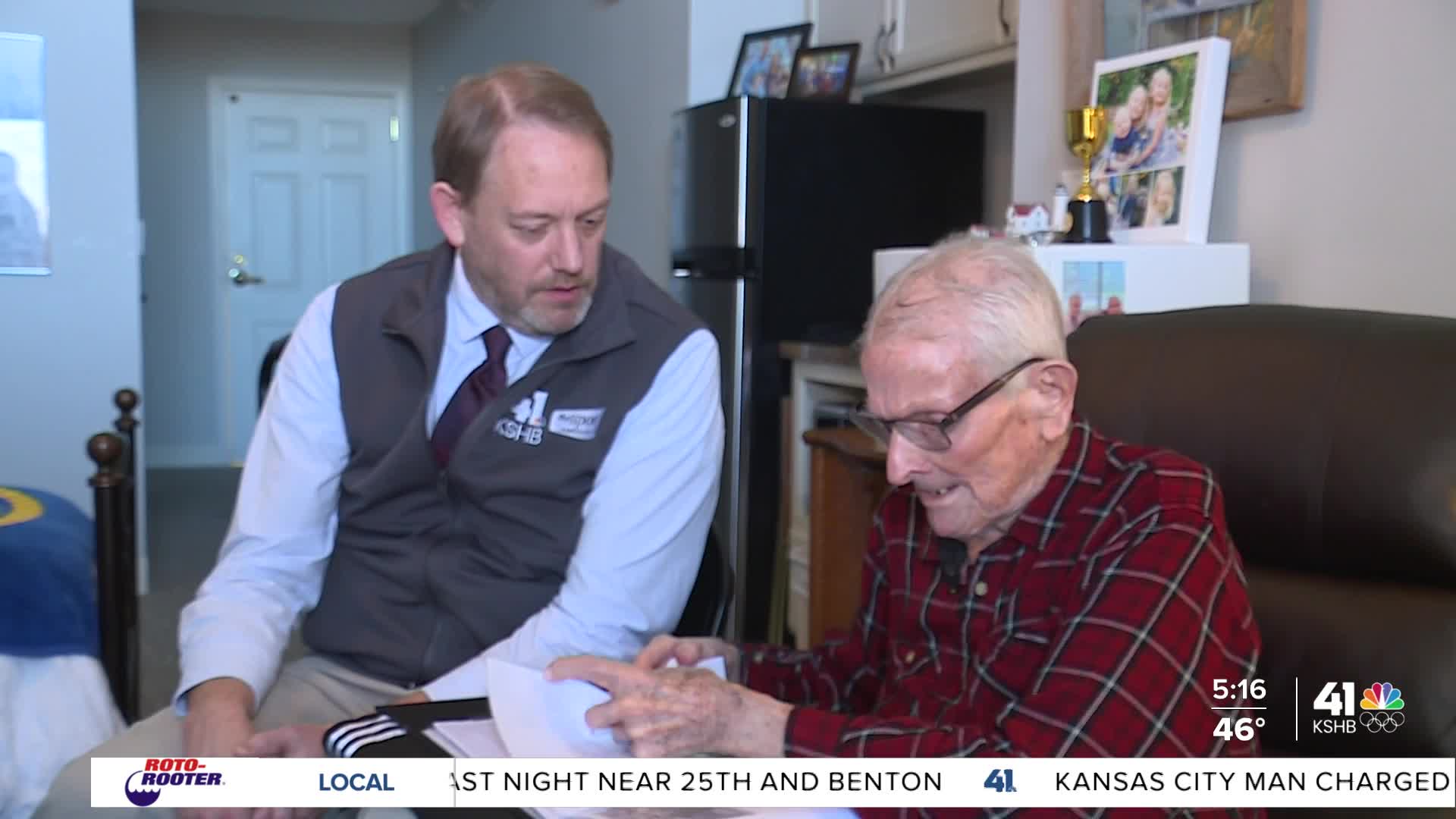


KSHB 41 reporter Tod Palmer covers sports business and eastern Jackson County. Share your story idea with Tod.
—
Don Sarver celebrated his 104th birthday last Thursday.
The former World War II torpedoman believes it’s his hope for the future that keeps him going.
“I came from a big family," said Sarver, who had three brothers and three sisters. “I knew there were lumps as you go along in life — the sadness and the joy — and I just have always thought ‘Tomorrow is going to be a better day.’”

It was hard to get better than the day Sarver — who was born on Jan. 15, 1922, and grew up near West 6th Street and Broadway Boulevard in Kansas City, Missouri — signed with the Detroit Tigers’ farm system.
“Three of us from Kansas City all went to spring training, and we all made it,” Sarver said.
With a few days off before he was required to report to the team, he hopped a train back to Kansas City, returning with the news and to find his beloved Mannetta. She worked for Sears and Roebuck at the time, and Sarver beat her home that day.
“I was waiting out on the swing on her porch, and I said, ‘Nettie, I made the team, and I want to play baseball, but I don't want to lose you,’” Sarver said.
She called her friends, and he gathered his. The next day, they were married.
“We were meant for each other,” Sarver said.
He and Nettie were married for nearly 75 years before she died in 2015.
Their marriage started with Sarver heading off to chase his big-league dream. Sarver’s older brother, Bill, already played in the Yankees' farm system.
“He was going to be the next center fielder for the New York Yankees, no doubt,” Sarver said. “He was better than Mickey Mantle or any people like that.”
After one season of minor-league ball, the U.S. was drawn into World War II. Sarver then got drafted, joining the U.S. Navy and heading off to Torpedo School in Washington state.
“I was going to go to Abilene, Texas, a step higher (in Detroit’s farm system), but the war came along,” Sarver said.
Instead, he proudly served aboard the USS Alvin C. Cockrell. The destroyer escort started the war battling German U-boats in the Atlantic Ocean, before moving to the Pacific Theater for the duration of World War II.
The Cockrell — which was defending Tinian Island, where the atomic bombs dropped on Hiroshima and Nagasaki were being assembled — was the second ship to arrive in July 1945, after the sinking of the USS Indianapolis, the greatest naval disaster in U.S. history.
“The scenes that I had to be part of,” Sarver said before pausing. “I could never forget — God.”
Nearly 900 sailors from the Indianapolis died after Japanese forces torpedoed the heavy cruiser, which was delivering material for the atomic bombs. Three hundred sailors went down with the ship, while the rest went into the water, where they endured shark attacks and suffered dehydration.
Only 316 of the Indianapolis' crew survived.
Sarver’s job was to disarm torpedoes aboard the Cockrell by removing the impeller that armed the explosive.
“The weight of that bomb was attached to these bodies, and they were buried that way,” Sarver said before choking up. “... Occasionally, I sit here and think about that, but I keep going. You can’t stop.”
Even after learning that a sniper killed Bill in Cologne, Germany, Sarver has never doubted that “tomorrow is going to be better.”
Jennifer Henning — an activity assistant at Sarver’s senior-living community, Brookdale Wornall Place — reached out to KSHB 41 about telling Sarver’s story after his 104th birthday last week.
“We're not supposed to play favorites, but it's really hard not to have Don as a favorite,” Henning said.
She added, “Don is one in a billion. He is one of the most selfless human beings you could ever meet. ... He's so sweet and loving and caring. He brings love and sunshine into every room that he enters.”
Sarver said Henning’s exercise class and “edible bingo” in the afternoons, where he often wins giant candy bars to share with other residents, give him hope these days.
“Anything to keep me going, get out of here and be helpful to somebody,” he said.
—