

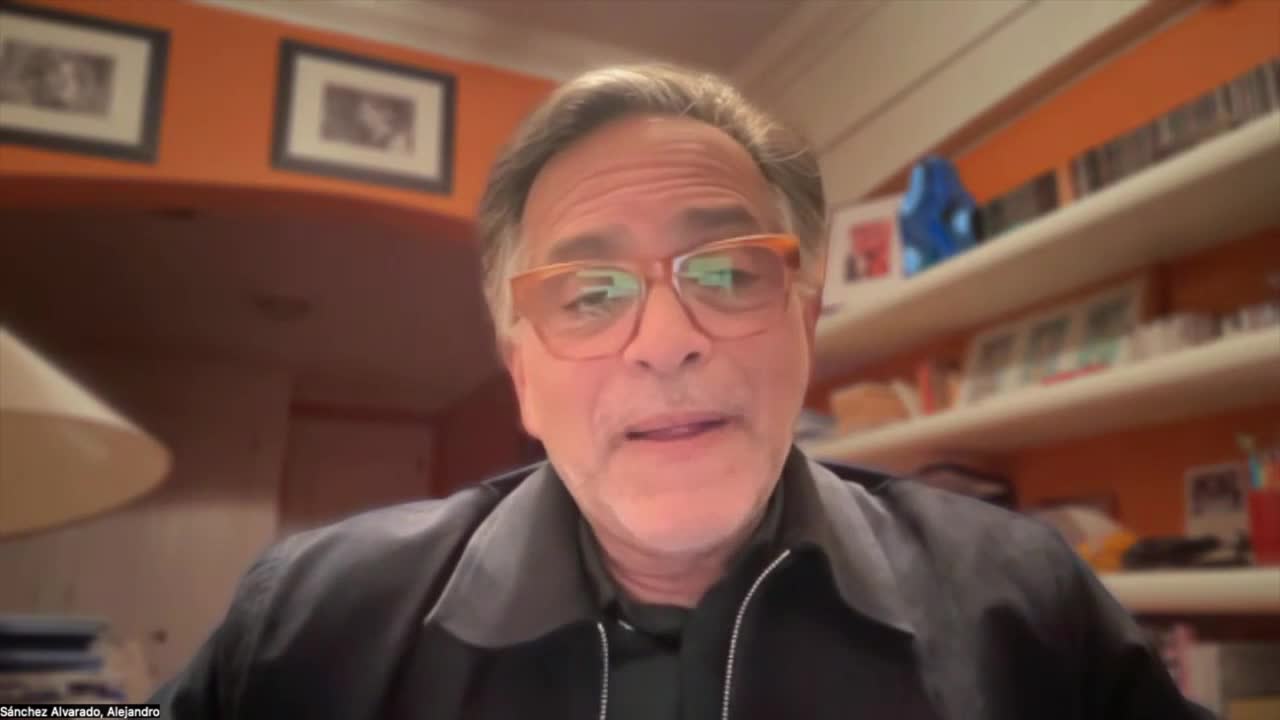


KANSAS CITY, Mo. — Recently on Facebook, I asked KSHB 41 viewers to tell me some stories or content they'd like to hear more about, maybe in the form of deeper conversations.
One response I got was from The Stowers Institute for Medical Research, right here in Kansas City. If you're not familiar, it's a world-class facility that's focused primarily on gaining a better understanding of human biology and health, and finding ways to combat diseases.
I'm going to start speaking monthly with the Institute's President and Chief Scientific Officer Dr. Alejandro Sanchez Alvarado, in a segment I'm calling "Under the Microscope."
Watch the full interview in the video player below:
For this first conversation, I wanted to pick Dr. Sanchez Alvarado's brain about artificial intellingence, and its role in the high-level scientific work that he and his colleagues do everyday.
"I'm not getting any younger," he told me. "And so the limited time that we have is much better spent really thinking through the meaning of what we're trying to do in a biological context, as opposed to sifting through mountains and mountains of data, in the hope that we'll be able to identify patterns, and from those patterns, derive a hypothesis. And so, I'm optimistic about the particular use of AI for this purpose."
But that doesn't remove the enormous value of longer-form research and experimentation.
"When it comes to like, you know, dealing with something that we've never seen before, there's no machine more advanced than our brain to think about the unknown," Dr. Sanchez Alvarado said. "The machines will only tell us what they already know, they are not generating any new knowledge. And that's because those processes are cut and dry. But when you're doing research, it does take a lot of time to deal with the unknown, and try to put in the framework of what we know. That's something that cannot be rushed, it needs to be protected, and if it's not cultivated we will not be able to make progress as quickly as we need to."
And so, Dr. Sanchez Alvarado and his colleagues don't seem to have the cut-and-dry view of AI that so many people are now adopting, either positively or negatively.
But during our conversation, he acknowledged the possibility of both outcomes.
"Yes, it can be abused. Yes, it can be used for nefarious purposes," he told me. "But I think that by the same token, it can be used to do tremendously beautiful things, tremendously meaningful and useful things. And it really all depends on us, us humans, to decide. You know, how are we going to put this new tool to use? Is it going to be a force for good? Is it going to be a force for evil? That decision is entirely ours to make."
This first edition of Under the Microscope was conducted over Zoom, but the hope is that future interviews will be done in person.
And there will be other topics, some of which were suggested by viewers, in the weeks and months to come.
—
