

KANSAS CITY, Mo. — KSHB 41 reporter Isabella Ledonne reports on stories in Overland Park, Johnson County and topics about government accountability. She's been reporting extensively on synthetic 7-OH and kratom in the ongoing I-Team series, Strong High Weak Laws. Share your story idea with Isabella.
—
A product that used to be widely available across the Kansas City area now finds itself the target of officials seeking to strengthen regulations on both sides of the state line.
Synthetic 7-OH is now illegal across Kansas, and is on track to become illegal in Missouri.
When KSHB 41 News reporter Isabella Ledonne first launched the I-Team series, Strong High Weak Laws, 7-OH was completely legal and unregulated. Five months later, the product's creator could soon be shut down pending a state lawsuit.
Kansas City is at the epicenter of what leaders have called an epidemic with "gas station heroin."

"[7-OH] should be banned," Kansas City, Missouri, City Councilman Nathan Willett said. "It is absolutely terrible — you've seen what it's done to certain folks in our community."
The Missouri Health Department and Senior Services, and other medical experts, have reported 7-OH to be stronger than morphine and highly addictive.

“How come I can go buy Gatorade at the same place I can buy something that can get me high?"
That's a question posed by Joey Thomas, who serves as a recovering housing manager at Healing House KC.
Kansas Governor Laura Kelly signed a bill last week that adds kratom and its synthetic derivative, 7-OH, as a Schedule I substance.
That's the same category as heroin.

"I think it would give law enforcement the teeth when they see it or recognize it on somebody to be able to arrest or charge somebody," Midwest HIDTA Executive Director Daniel Neill says.
Kansas City, Missouri, banned 7-OH in city limits in February 2026. On Thursday, the council approved an ordinance requiring kratom sellers to apply for a special license like alcohol and tobacco permits.
It's part of the February ordinance to further regulate natural kratom as a 21-and-up product. The license will cost retailers $500.
"It should not be at gas stations. Tt should not be readily available," Willett said.
Synthetic 7-OH was one of the most accessible drugs in Kansas City for a few years, costing as little as $10. The Food and Drug Administration sounded the alarm on 7-OH in August 2025, two years after a Kansas City-based company, American Shaman, started selling it on the market.
In November 2025, the Kansas City, Missouri City Council started looking into regulations for 7-OH and kratom. Around the same time, the FDA seized more than 70,000 products from American Shaman's warehouses.
KSHB 41 News reporter Isabella Ledonne sat down with American Shaman's founder, Vince Sanders, in December. He defended 7-OH's safety amid the federal and state investigations, and explained he's seen millions of dollars in profit.

"The vast majority of people that are using too much 7-OH would be using fentanyl otherwise, and would be a whole lot worse off," Sanders said.
Kansas City banned synthetic 7-OH in February. Both Missouri and Kansas legislatures introduced bills to ban the synthetic product statewide.
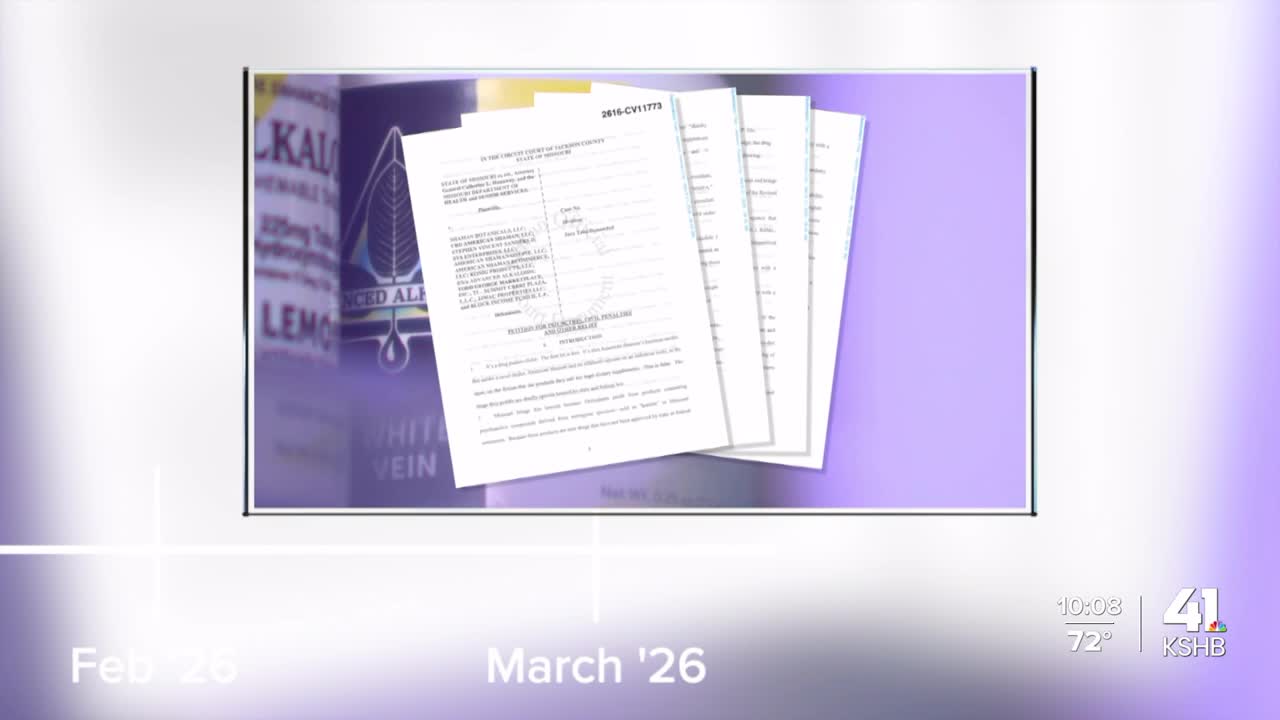
Two weeks ago, Missouri's Attorney General filed a lawsuit against American Shaman and asked the court to shut down operations.
"Kansas City led the region. I'm very proud of that," Willett said.
Missouri's bill proposing a statewide ban has been perfected in committee and is currently scheduled to be brought up on the floor. A spokesperson for Missouri Sen. Maggie Nurrenbern (D - Sistrict 17), the Clay County elected official who first proposed the bill, told KSHB 41 News they are hopeful the bill will make positive progress in the last four weeks of the session.
—