



JOHNSON COUNTY, Kan. — KSHB 41 reporter Isabella Ledonne reports on stories in Overland Park, Johnson County and topics about government accountability. She's been reporting on synthetic 7-OH extensively in the ongoing I-Team series, Strong High Weak Laws. Share your story idea with Isabella.
—
The Drug Enforcement Administration is moving to make synthetic 7-OH illegal nationwide, filing its intent to temporarily schedule it as a Schedule I substance.
That's the same category used for heroin.
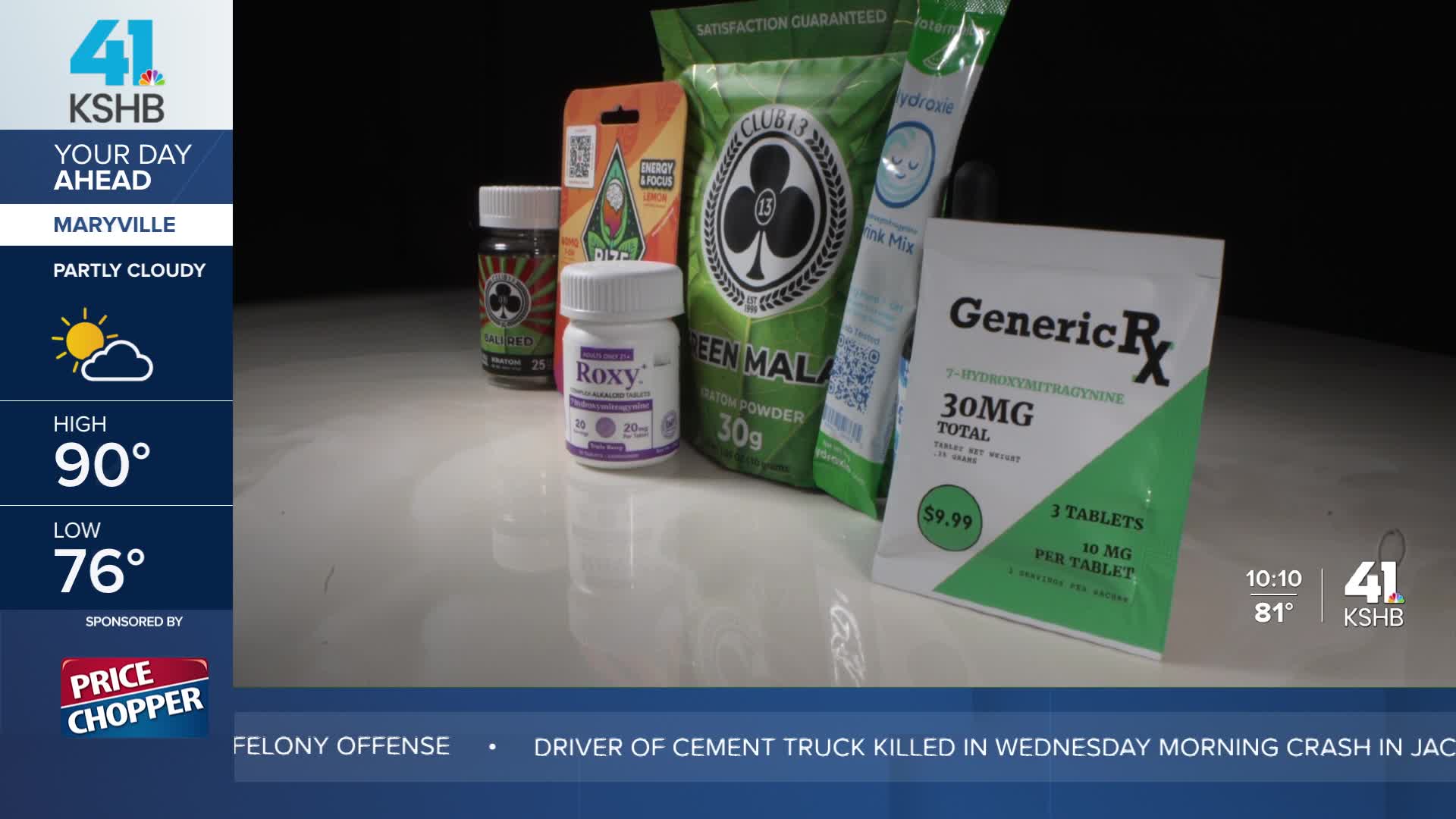
7-OH, a synthetic derivative of the plant kratom, has been a recent target for lawmakers across the metro area. Until recently, it was considered legal and unregulated.
Wednesday's announcement comes on the same day the 7-OH and kratom ban takes effect in Kansas. Johnson County officials report synthetic 7-OH has already contributed to several overdose deaths in 2026.
KSHB 41 News Reporter Isabella Ledonne has reported on 7-OH and kratom extensively in the I-Team series, Strong High Weak Laws.
The substance is often referred to as gas station heroin, getting that name from being sold over the counter at convenience and corner stores across the country.
"It's just as dangerous, if not more, than fentanyl," Johnson County's Chief Medical Examiner and Coroner, Dr. Diane Peterson said. "We have seen an increase in the number of cases where we have identified 7-OH products on scene."
According to Dr. Peterson, 7-OH has been a factor in six deaths in the last six weeks. There was one 7-OH-related death in 2025 in Johnson County.
"It says to me that the choice is moving," Dr. Peterson said. "Our fentanyl deaths are going down, and so the drugs of choice are shifting. It was very frustrating that it was so easily obtained and that there was no regulation."
Earlier this year, the Kansas Legislature passed a law that makes kratom and all of its derivatives, including 7-OH, illegal.
The Johnson County District Attorney's Office has been cracking down on the businesses selling the products.

"I do find it offensive that they're selling these products that are killing people and any business acting in good faith would not do that," Johnson County District Attorney Steve Howe said.
Businesses and residents can still drop off 7-OH and kratom products at the Johnson County Sheriff's Office with no penalty. Any possession or sale of the substance could result in up to a Level 3 Drug Felony and potential prison time.
"It's a harmful, addictive substance," Johnson County Sheriff's Office Captain Craig Walion said. "Getting rid of that will give us a leg up in the fight on drugs."
Until the DEA's announcement on Wednesday, kratom and 7-OH were regulated on a state-by-state basis. It's now illegal in Kansas, but it is still legal in Missouri, although it's banned in several cities across the state.
"I'm not so naive to believe that we're going to have zero cases because they can't get it here, and we know that [Missouri] is a short drive away," Dr. Peterson said.
But the DEA's temporary scheduling would ban it nationwide and that could make enforcement less challenging.

"Removing it from the shelves will be a step in the right direction because we won't be able to have it come from one state to another with the 50-state ban on it at the federal level," Captain Walion said.
Johnson County reports it has some of the highest rates of non-fatal emergency calls for kratom and 7-OH in the state. It's a number Dr. Peterson is hopeful will go down with the new bans.
"At the end of the day, it will improve public health overall," Dr. Peterson said. "It will be beneficial overall, even if it doesn't completely eliminate it 100%."
The region's main producer of 7-OH, American Shaman, recently settled in a lawsuit with the Missouri Attorney General. The company agreed to not sell or manufacture 7-OH products in the state.
—

![092126_KSHB_WX_480x360[61].jpg](https://ewscripps.brightspotcdn.com/dims4/default/79e7fad/2147483647/strip/true/crop/480x360+0+0/resize/960x720!/format/webp/quality/90/?url=http%3A%2F%2Fewscripps-brightspot.s3.amazonaws.com%2F6f%2F6d%2Fa3758caf4c0984b0ecf100f620d1%2F092126-kshb-wx-480x36061.jpg)