




LEAVENWORTH, Kan. — KSHB 41 reporter Rachel Henderson covers neighborhoods in Wyandotte and Leavenworth counties. Share your story idea with Rachel.
—
The Leavenworth City Commission voted Tuesday to grant private prison company CoreCivic a special use permit to operate an ICE detention facility in the city, ending a costly legal battle — though the courts have not yet fully resolved the case.
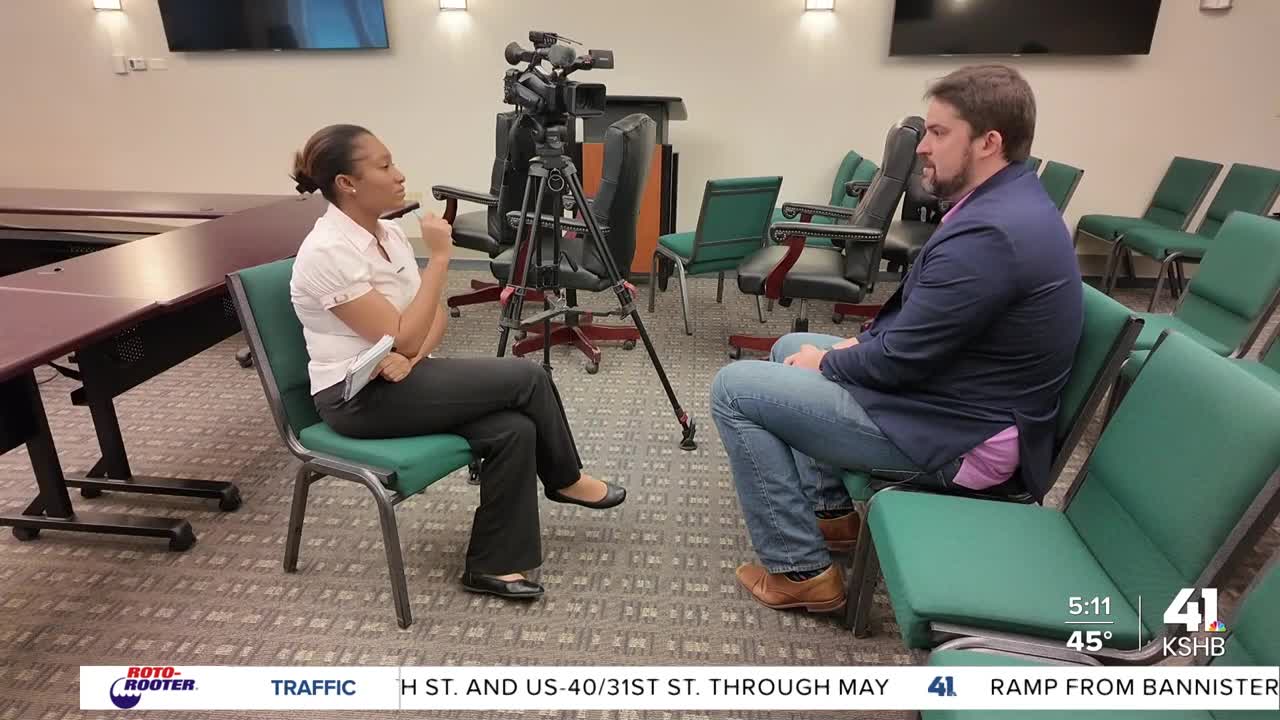
I was inside City Hall Tuesday night when the commission took the vote, and I returned the next day to hear from city leaders about their decision.
Mayor Nancy Bauder, who voted yes, acknowledged the tension between her personal feelings and her role as an elected official.

"I'm representing the city,” Bauder said. “If I wasn't, I probably would be there with the protesters. My son lives in Minneapolis. I don't like what they've done there. I don't like what they've done in Portland, where my cousin lives.”
She said she agreed with her fellow commissioner, former Mayor Holly Pittman, who said her yes vote didn't equal an endorsement of CoreCivic.
Bauder was also direct about her concerns with how ICE has operated elsewhere.
"Having ICE do what they've been doing is horrible, and the way they've been treating people and the way they've been arresting people who aren't guilty of anything, but I have to protect the city," Bauder said.
She said the city could no longer sustain the financial burden of fighting CoreCivic in court, and she didn't want to create a future tax burden for residents.
"We can't afford to keep fighting CoreCivic. Another thing, we're just a small town," Bauder said. "I'm mayor of the city, I'm on the city commission and I have to protect our city here. And we can't bankrupt the city fighting CoreCivic or any other organization.”
Up until this point, the legal fight has cost the city nearly $1 million, according to City Manager Scott Peterson. However, he noted the city recouped most of it and more through an impact fee from CoreCivic.
Still, the legal process is not over.
The Kansas Court of Appeals sided with the city weeks ago when a judge issued a temporary injunction that banned CoreCivic from opening until the district court case had been heard.
"In theory, the whole case still has to be heard," Peterson said.
Peterson said he expects the legal proceedings to wrap up quickly now that the vote has taken place.
"My guess is by the end of it, things will get cleaned up pretty quick," Peterson said.
Peterson said the commission achieved what it set out to accomplish through the legal fight.
"The city commission got what they fought for," Peterson said. "The authority for CoreCivic to operate in the city of Leavenworth is now in the hands of the Leavenworth City Commission.”
With Tuesday's vote, CoreCivic is now free to open.
A CoreCivic spokesperson told me the company is waiting for direction from ICE on when that will happen.
Peterson said CoreCivic plans to ramp up gradually.

"I did know that they plan on kind of ramping up because they're not fully staffed right now, so they're going to bring in a few at a time to figure out the process, make sure it works the way they want it to," Peterson said.
Peterson said the city will be watching closely to make sure the facility is run properly.
"Nobody's going to pull any wool over the city's eyes in terms of how it should be operated," Peterson said. "That's why the special use permit was so important to us, is that now the city's in control.”
The city outlined 17 conditions CoreCivic must follow in order to keep the permit.
Those conditions include granting police access for emergencies, improving the sewer system, not releasing detainees into the public, and creating a community relations board to monitor facility operations.
Other conditions include that only adults 18 and older may be detained at the facility, and that the facility should not house more than 1,104 inmates at any one time. CoreCivic must receive written approval from the city’s fire chief in order to exceed this amount.
You can read the other conditions in detail starting on page 23 of the city’s Tuesday agenda.
Peterson said those conditions were the result of negotiations with CoreCivic.
"You can't just make up some lavish requirement to force CoreCivic to follow, so that was a balancing act that we had to try to find this whole time. It involved negotiations with CoreCivic," Peterson said.
Peterson said Leavenworth's history gives the city a unique perspective on what proper prison operations look like.
"You'll hear this a lot here, we are a prison town, but that also means we know what a good prison looks like when it's operating properly," Peterson said.
Bauder said the permit gives the city real leverage if CoreCivic fails to follow the rules.
"The best way to move forward is to work with them and make sure that we have the special use permit,” Bauder said. “If those conditions are not followed, we can pull the special use permit.”
She also pointed to CoreCivic's staffing as a reason for confidence.
"Part of the problem with the for-profit prison in the past is they haven't followed the rules,” Bauder said. “So I feel better about it knowing that there are former corrections officers working in CoreCivic. I trust them to be telling me the truth when they say they're going to do their best."
Bauder said she believes having the facility in Leavenworth is preferable to the alternative.
"If detainees have to go somewhere, I'd rather have them come here where we can take care of them," Bauder said.
Not everyone on the commission agreed with the permit's current state.
Mayor Pro Tem Rebecca Hollister cast the dissenting vote, saying she needed more time and more answers before she could support the permit.

"I needed some more clarification on certain things in the permit," Hollister said.
Hollister said she had several specific concerns, including wanting the permit reduced to two years instead of three, wanting religious access provisions extended to groups outside of CoreCivic, and wanting stronger language around the permit's default clause.
As written, the clause gives the city the opportunity to rescind the permit after written notice and 30 days of a violation, but Hollister said she would have wanted to explore whether a violation needed to be continuous over those 30 days or could be intermittent.
She also said she would have preferred to send the permit back to the planning commission for further consideration.
Hollister said constituent voices played a partial role in how she approached the vote.
"I would say constituents did play a role," Hollister said.
She described the atmosphere at Tuesday night's meeting as charged.
"There were some intense moments last night, but it's definitely understandable," Hollister said.
Despite her no vote, Hollister said she plans to continue working on her concerns through the oversight process and says she and her fellow commissioners work well together.
"I think definitely some of my concerns I'll want to address to that task force," Hollister said.
She said rebuilding community trust will be essential going forward.
"I think we just have to continue to hear the voices of our constituents and get some really hard work in to rebuild that trust," Hollister said.
Bauder said she welcomes community involvement and respects those who oppose the decision.
"I feel for the protesters and for the citizens who came here and spoke,” Bauder said. “I feel for them.”

Dan McIntosh, a Leavenworth resident who spoke against CoreCivic at Tuesday’s meeting, spoke with me after the vote.
“The city faces protests, the city faces boycotts, our immigrant community goes into hiding,” McIntosh said. “Our minority communities that aren’t even immigrants go into hiding.”
Bauder addressed remarks like this on Wednesday.
"They have a right to speak, they have a right to protest,” Bauder said. “They have a right to boycott and go anywhere they want to go. I just think we're such a good community, and we're going to make it better."
Bauder said she wants residents and religious leaders to be part of the oversight effort going forward.
"We need to move on and make sure the people that are detained here are protected and taken care of," Bauder said.
This story was reported on-air by a journalist and has been converted to this platform with the assistance of AI. Our editorial team verifies all reporting on all platforms for fairness and accuracy.
—

![092126_KSHB_WX_480x360[61].jpg](https://ewscripps.brightspotcdn.com/dims4/default/79e7fad/2147483647/strip/true/crop/480x360+0+0/resize/960x720!/format/webp/quality/90/?url=http%3A%2F%2Fewscripps-brightspot.s3.amazonaws.com%2F6f%2F6d%2Fa3758caf4c0984b0ecf100f620d1%2F092126-kshb-wx-480x36061.jpg)