



JOHNSON COUNTY, Kan. — KSHB 41 reporter Elyse Schoenig covers Johnson County. She also focuses on issues surrounding the cost of health care, saving for retirement and personal debt. Share your story idea with Elyse.
—
Property taxes in Johnson County have been a major topic of concern for many residents, especially retirees worried about being priced out of their homes.
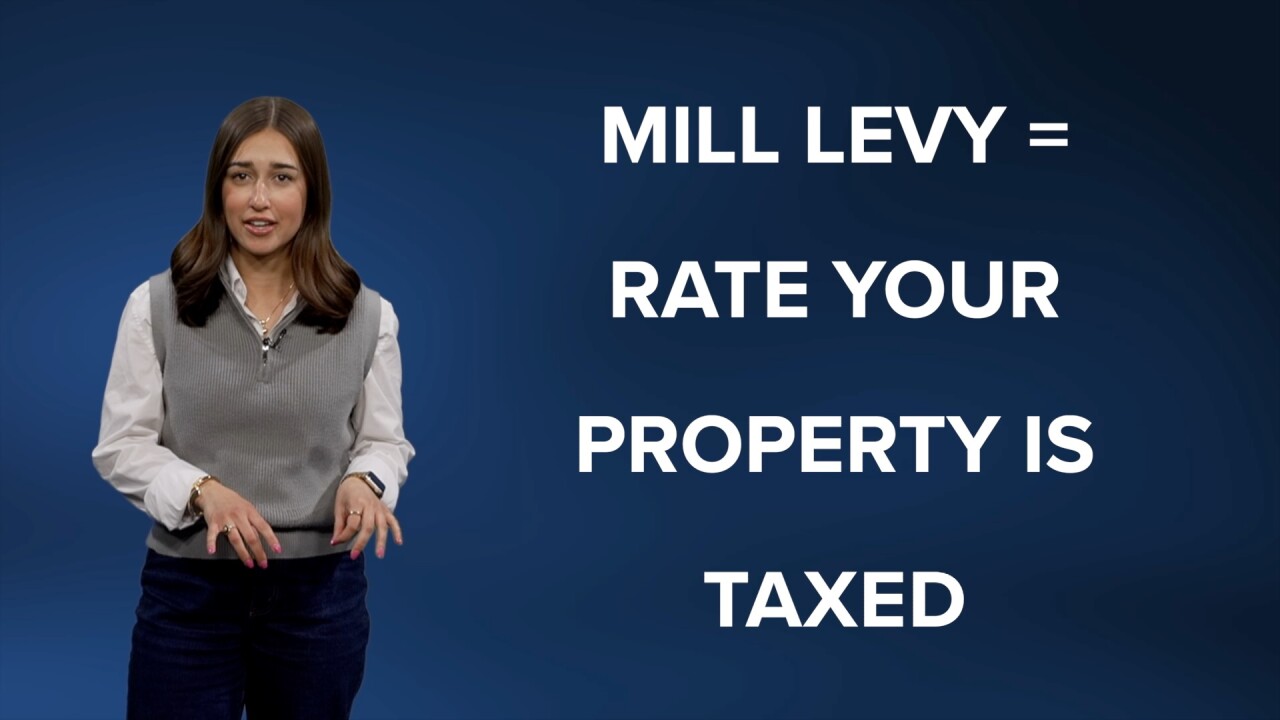
But the assessed value is only half of the story. The other half is the mill levy, the rate at which your property is taxed.
Jane Zaccardi, a retired Johnson County resident, said the increases have been difficult to manage.
"Being a retired person and essentially [on] a fixed income, that kind of jump is not sustainable," Zaccardi said.

Fellow retiree Brady Vickery said he worries about his long-term ability to stay in his home.
"I want to live in this home for, well, as long as I can now, at this point, since I'm retired," he said. "And am I going to be able to do that and not get priced out of it because of taxes?"

A viewer reached out to KSHB 41 asking specifically about mill levies, prompting a closer look at how they work and why they matter.
To determine what you actually owe in property taxes, it all comes down to one formula: your assessed value multiplied by your mill levy, divided by 1,000.
That means your final tax bill is shaped by two separate factors — and both matter.
Using the Johnson County property tax calculator, KSHB 41 reporter Elyse Schoenig looked up the address of one Olathe resident to see how their tax bill breaks down. That resident owes nearly $6,000 in property taxes, which is split among six taxing authorities:
- Olathe School District
- City of Olathe
- Johnson County
- Johnson County Community College
- Johnson County Parks
- State of Kansas
The majority of that money goes to the school district.
An Olathe city official shared some insight with Schoenig on how Olathe factors its mill levy as part of its adopted budget.
The official said the city uses higher property values to pay rising city costs (personnel, medical, construction) rather than automatically cutting the tax rate. The city has lowered the mill levy in years when values grew faster than needed (in 2023 and 2024), but Olathe recently kept levies steady to balance budgets.
The official also said any additional property‑tax revenue is shown in the Budget Book and Annual Comprehensive Financial Report (ACFR) and applied to cover those rising costs.

Every year, each local taxing authority — such as your school district or city government — sets its mill levy rate to raise enough money for its budget. That means even if your assessed value increases, your tax bill won't necessarily go up.
If your local government lowers the mill levy, your tax bill could stay the same, or even go down. What local taxing authorities do with their mill levies is what ultimately determines what you owe.
It's complicated. But understanding both sides of the equation — your assessed value and your mill levy — is essential to knowing what you actually owe.
This story was reported on-air by a journalist and has been converted to this platform with the assistance of AI. Our editorial team verifies all reporting on all platforms for fairness and accuracy.
—

![020626_KSHB_Image_NXA_Web_Standard Cube[88].jpg](https://ewscripps.brightspotcdn.com/dims4/default/0ead409/2147483647/strip/true/crop/300x225+0+13/resize/960x720!/format/webp/quality/90/?url=http%3A%2F%2Fewscripps-brightspot.s3.amazonaws.com%2F8f%2F6c%2Ffad8bd2346c5a4d4ead793017d4a%2F020626-kshb-image-nxa-web-standard-cube88.jpg)