




KANSAS CITY, Kan. — KSHB 41 reporter Rachel Henderson covers neighborhoods in Wyandotte and Leavenworth counties. Share your story idea with Rachel.
—
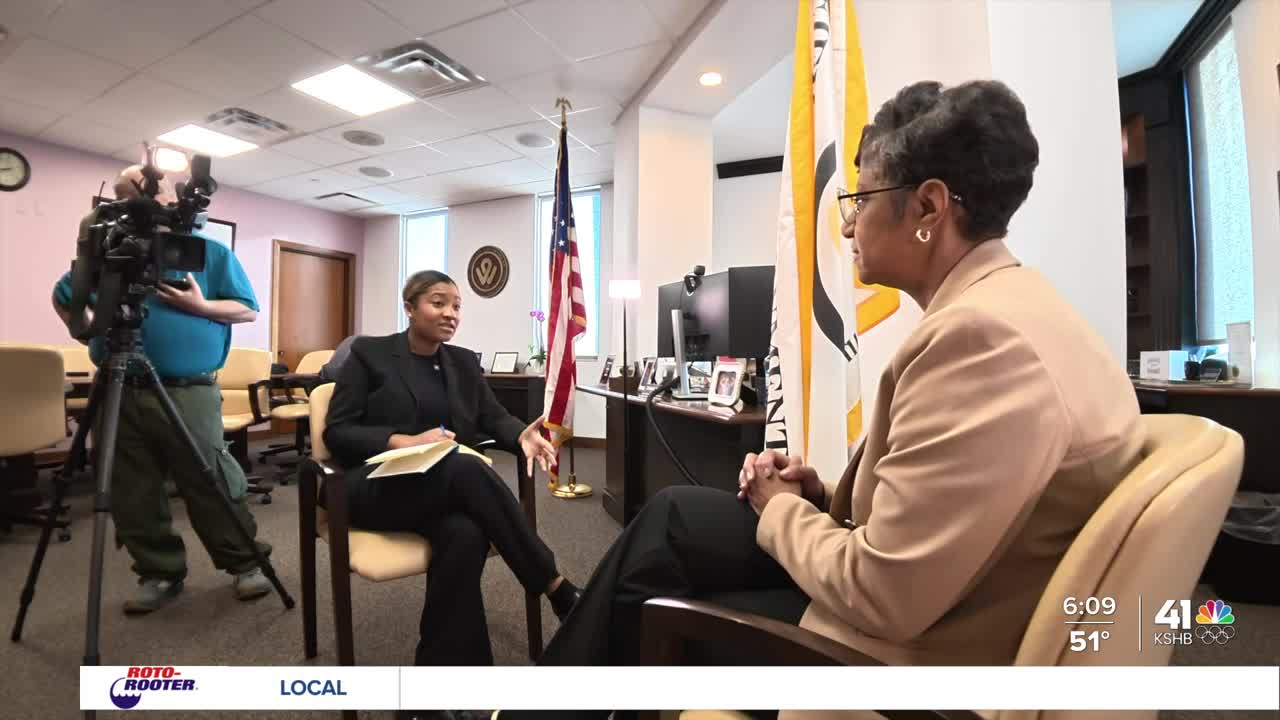
Kansas City, Kansas, Mayor Christal Watson is defending the county commission's decision to approve a STAR bond district for a new Chiefs stadium despite dozens of residents expressing concerns about potential tax increases.
"We did not give away Wyandotte County," Watson said during a nearly 30-minute interview with KSHB 41’s Rachel Henderson on Tuesday morning.
Watson revealed she had little advance notice about the Chiefs' potential move, learning about the possibility just a week before her inauguration.
"Initially, I just got a phone call that the state wanted to build a relationship with the mayor's office, and so that was really kind of exciting," Watson said. "Literally a week before the inauguration is when I found out that the Chiefs could possibly be here. And then several days after that, it was, 'They are coming.'"

Wyandotte County commissioners voted 7-3 for an ordinance to approve the STAR bond district, which means part of the county's sales tax will help fund the new Chiefs stadium.
However, the decision doesn't change the amount of sales tax residents pay.
Watson acknowledged she and the commission will do their best not to raise other taxes, but it's not a guarantee.
"Nothing's a guarantee,” Watson said. "I don't guarantee anything. What I can say is that the commission board and the staff here at the UG are very focused on avoiding raising taxes."
The tax issue dominated conversations with residents leading up to the vote.

One resident expressed concerns about affordability.
"I'm on a fixed income, and I can barely afford to pay my taxes," the resident said.
Watson said she understands residents' fears but emphasized the deal is designed to avoid tax increases.
In a Facebook post she made the morning after the vote, she emphasized that one of the conditions of the local sales tax pledge means the UG has approval rights over agreements that dictate how the project is "built, funded and operated."
"I hope people understand what we want to do is to protect our residents as much as possible," Watson said. "We're trying to avoid any opportunity of raising taxes because we know that's not what our community wants."
Despite the controversy, Watson said she's received positive feedback after the vote.
"After the fact, I've gotten nothing but positive remarks," she said. "It's kind of crazy because I thought people would [say], 'I can't believe you did that,' or, 'You're the commission, you should be ashamed of yourself.'"
Watson emphasized the importance of maintaining a good relationship with the state, noting that prior to her term, the county's relationship with Kansas was practically nonexistent.
"I think the most difficult thing about it was the state made a decision without initially having a conversation with us," Watson said. "For four years, there was no relationship, and now there is. And now we're starting to see some benefit from it before the deal is even made."

The mayor pointed to recent state funding as evidence of improved cooperation.
Gov. Laura Kelly allocated $135 million for the Central Avenue Bridge and $1.5 million for transportation buses.
"If they want to do other things to help Wyandotte County because we said yes, bring it on," Watson said.
Watson said the decision came down to weighing consequences.
"I had to ask myself, 'What are the consequences of saying yes and what are the consequences of saying no?'" Watson said. "I think there's a greater opportunity for consequence to be more detrimental if we did not consider the relationships and building on those relationships for the betterment of our community."
The mayor stressed that the county maintains control over future decisions, with final approval required for any expansion of the STAR bond district.
Watson says she and the commission don't want the district to expand to include the entire county.
"I can say we don’t want that. At the end of the day, we need to have a seat at the table, and saying no may not have given us that," Watson said. "Because we hadn't had a seat at the table with the state for the past four years, if we had it, would we be in the situation we're in today? I don't know. I'm not willing to take that risk again."

When asked if there's a scenario where the county would say no if the deal doesn't benefit Wyandotte County, Watson paused.
"That's a good question," Watson said. "Honestly, I don't know."
The stadium and surrounding services won't be completed until 2031, giving Watson time to focus on building the tax base through other development opportunities.
She says she wants to focus on the area east of Interstate 635.
"You can't miss what you don't have,” Watson said. “We don't have that yet, so we're not missing anything yet. The focus for me is what happens between now and the time that stadium is built."
Watson plans to start town halls in March and remains open to community input.
"Hold tight. Give us some grace to get through, and give us a chance to show them what we're capable of doing," Watson said. "I’m not in some big tower looking down; I am right there with the people because I am part of the people."
This story was reported on-air by a journalist and has been converted to this platform with the assistance of AI. Our editorial team verifies all reporting on all platforms for fairness and accuracy.
—
![092126_KSHB_WX_480x360[61].jpg](https://ewscripps.brightspotcdn.com/dims4/default/79e7fad/2147483647/strip/true/crop/480x360+0+0/resize/960x720!/format/webp/quality/90/?url=http%3A%2F%2Fewscripps-brightspot.s3.amazonaws.com%2F6f%2F6d%2Fa3758caf4c0984b0ecf100f620d1%2F092126-kshb-wx-480x36061.jpg)