



KANSAS CITY, Mo. — KSHB 41 reporter Tod Palmer covers sports business and eastern Jackson County, including Independence. Share your story idea with Tod.
—
Jackson County residents will elect a new county executive Nov. 3.
The recent history of the job hasn’t exactly been distinguished and county residents remain angered over the 2023 reassessment process among other ongoing issues.
Alan Rohlfing was the lone Republican to file for the office, while Stacy Lake emerged from a crowded field for the Democratic party nomination.
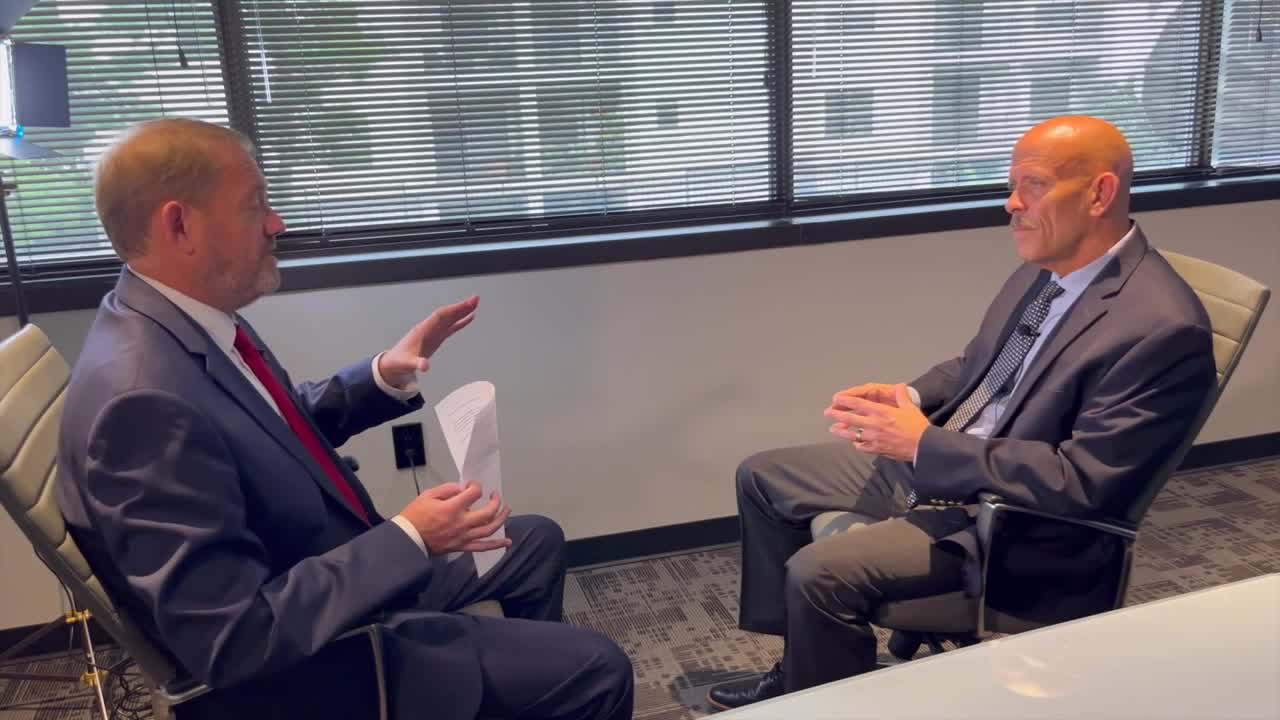
KSHB 41 Jackson County Reporter Tod Palmer sat down with both candidates.
—Watch our conversation with Rohlfing—
Below is a transcript of the Q&A, lightly edited for clarity:
KSHB 41 Jackson County Reporter Tod Palmer: Alan Rohlfing, Republican nominee for Jackson County Executive. I appreciate you joining us today, and I guess I just want to start: Why did you run for county office? What drew you into this race, and what are you hoping to accomplish as a candidate for this position?
County Executive Candidate Alan Rohlfing: Well, thanks for having me today. When we talk about why am I running, it's a common question. It's usually one of the first ones that come up because, like it or not, there's been a lot of attention on the office of Jackson County executive and Jackson County government at large.
At the end of the day, I read the news, I have the social media feeds that everybody else has, and I think it's really just a matter of I wanted to help. I think our county government and the services that it provides are tremendously important for a lot of people. But some of those departments within county government, they need help.
So, my ultimate goal is to restore public trust and confidence, to help restore that public trust and confidence, in our county government with an end game of delivering world-class customer service to the residents of Jackson County. That's kind of how I'll go about my daily business, always with the residents in mind.
Palmer: That leads me into my next question. To borrow a phrase I've heard in talking to Jackson County residents, they want to feel like there are adults in the room again when it comes to our county governance.
We've had the recall of the county executive, the interim county executive is under federal indictment, the legislature, for a while, has been beset by infighting and issues like that.
How do you restore that public trust and present a county government that people can have faith in and that is functional for the people of Jackson County?
Rohlfing: I think it'll be a process — and it's not going to happen on day one, but it'll start on day one. Between creating an environment — so, I'm speaking as the county executive, right, the administrator of the county services, the chief executive for the county, the leader of the organization, if you will — to create an air of respect and collaboration within county government at-large.
I agree with you that there needs to be more of an air of cooperation between the legislature, between the county executive's office.
From what I can see, from what I've heard, the folks that I tap into to learn more about (it). I'm learning every day about Jackson County government, about the history, the challenges, everything that we face to operate as an organization to deliver the services we're required by law to provide, and that our residents need quite frankly.
As I get smarter in that space, on day one it becomes a matter of improving the organization.
To me, we can talk about reforming and modernizing or transforming, or whatever word you want to talk about, but that doesn't always mean, and it doesn’t have to mean, bigger government. I think it means better government.
And I think that's where we start: is improving the organization. It's getting to the point where we establish those standards of performance, we train to those standards, make sure that we've communicated those standards and what success looks like, what right looks like to all the county employees. We train to that, and ultimately we get to a point where we hold we hold our county employees accountable for meeting those standards, and that's where we get to that world-class customer service that our residents all deserve.
Palmer: So, if you're elected and you're sworn in in January, can you give me three priorities that you'll have that first year or pretty immediately upon getting into office to help begin the process of restoring that faith and making the government work toward that end of excellent customer service?
Rohlfing: Sure, I've got about a dozen of them, and that list will be longer. I'm big on as I mentioned about improving the organization, but improving the position too and improving how the county executive plays well with the legislature and vice versa, building those bridges or rebuilding those bridges.
But there will always be the tenets of my platform. That's what we communicate to the residents, to the voters, obviously, on what we want to do when we get to office.
That issue that's front and center for everybody — legislators, county executive candidates alike — is that property assessment and taxation reform. It's the low-hanging fruit that needs fixing now.
There are some things that we’ll continue. I like some of the things that have been put in place, codified into county law, so that's that's good. But I think there's some other things that we can, perhaps that that we can implement to maybe dovetail with what's in place, all with the point of making those taxpayers whole that maybe still are out there.
So, it's improving, reforming property assessment and taxation. It's also just strengthening the delivery of our core services.
Of course, it's going on now. The core services are being delivered as we speak, and it'll continue.
When I talk about strengthening that delivery, it's about improving the efficiency of the offices that do that or it's about increasing their transparency. It's about keeping some of those groups — like first responders and seniors and veterans — keeping them kind of front and center as far as that they're always they're always being considered when budgeting or when service delivery comes into play.
The other thing I'd really like to focus on, if I had to whittle it down to three, would be to reinforce a small-business-friendly attitude within the county. Again, just like many of our other candidates, I hear those stories that you're like, “Oh, we can't do that. Why is it that way? Why is it so hard to do business?”
Whether you're seeking permits or whether you're just trying to speed up the process so you can spend time running your business rather than navigating the county bureaucracy, I just want to make that more small-business friendly and and and and focus on the businesses that we have — which will, in turn, I think help with future economic development priorities down the road.
Palmer: I want to drill down a little bit on the assessment department. Right now, the county doesn't have anyone. Gail McCann Beatty has not been replaced as the the director. It's going to transition to an elected position in 2028. But one of the first things you're going to have to do when you get into office is the 2027 assessment cycle will be beginning and you're going to have to get that out. So, how do you reform it on the fly, if elected?
Rohlfing: Well, I think that'll be a process too, but it's going to have to be one that has a quick timetable on it because of the ‘27 reassessment.
I can say that anything that we do, anything that I do, is going to be reforms that that will transition well to that elected assessor, but we still have a couple years right before that all kind of comes in, and there's an actual election before they take office.
So, there is a specific list of things that, when you're talking about making things better with the government that we already have and do, some of those steps sound very similar. I think we try to assess where the assessment office stands currently.
We make some of those things that they do more transparent. We make it so that it's more viable, that it's easier to challenge when there are errors. We put those things in place.
But it's a little hard for me to identify exactly what needs to happen, because I'm not an incumbent in the office. I'm not sitting there saying, “Well, here's where we're short and here's what needs to be fixed.”
But probably what I have in mind — whether it's my opponent or the legislative candidates, I'm sure many of those have those same ideas — I think we focus on the the the office that we have, the resources that we have. I can't speak to why there's not an assessor in there right now, getting that office shipshape, but that will be one of the first things that we have to have to address.
Palmer: You kind of mentioned it, but Stacy Lake, your opponent: When it comes to wanting an audit, a deep-scale audit of Jackson County, when it comes to a focus on small business, when it comes to reforming the assessment department, you guys are actually in pretty strong alignment on some of those things about what you think the priorities should be. What do you think differentiates you from your opponent in this race?
Rohlfing: What most stands out to me is how we will get to the point of fixing what we think needs our attention and our emphasis.
Again, whether we call it reform or modernization, transformation, just fixing county government, those are those are words that can mean a lot of different things to a lot of different people. So, I think how we execute that is probably what sets us apart most.
I am more of a let's focus on the organization that we have. I don't believe that there's corruption around every corner. I don't want to come in and clean house, but I think we have to get to the point of knowing the organization better and knowing where we stand and and again what success looks like and how we're measuring success and communicating that, those standards of performance that I mentioned earlier. A lot of that is standard organizational management for large organizations. There have to be processes in place.
It's not just about people, but these people, these county employees that deliver the services that we're talking about, that we want to strengthen, that we want to keep delivering to the residents and the taxpayers of the county, those county employees — they're humans, too. They have mortgages, a lot of them, they have needs, they have their own trials and tribulations, so it's not about coming in and just cleaning house.
It's about giving them an opportunity to succeed, but sometimes they have to know what success looks like. We'll train to those standards, and we will get to the point that, if we need to hold people accountable, we will, because we need to be responsible with taxpayer dollars.
But my take is really let's start by focusing on the organization we have. As it stands, we can improve it and get to that point of delivering the service, that world-class customer service, that I talk about so frequently.
Palmer: How long does that process take in your mind? It doesn’t sound like it's a cheap or a fast process?
Rohlfing: Well, I think it can be a cheap process. Now, I say that with no dollar signs in mind.
I don't want to say that we've got to order this product or this audit or this team to come in and tell us where we stand. It's really about leadership. In the military, we call it frontline leaders, and it's really that immediate supervisor level.
Everybody has an immediate supervisor, right? Getting that to the point of them being trained well enough — and perhaps some of those are human resource functions, but it's about the training and giving them the resources.
But I don't think there are a lot of dollar signs necessarily attached to that. It's just about taking the time to train, and all the while there's training going on we're delivering the core services. We're not stopping. We're not taking a break. We're not saying, "Hey, let's get our stuff right before we actually move forward.”
That all happens. It's happening now, and it happens on day one.
What kind of time frame are we talking about? Well, I'd like to think (within) my first 60 days we'll know where we stand. We'll have a good assessment of what flaws we would like to attend to, what kind of shortcomings county government-wide that we can attend to, but this is a long-term continual process of making the organization great and keeping that organization great.
Palmer: How do you balance the needs of Kansas City, Missouri, and eastern Jackson County, which can be different. How do you, as an executive, walk that line and make sure that you're attending to all the varying needs of the varying pockets of the county?
Rohlfing: That is a great question. I'm sure there's a political answer to that question. But as everybody that knows me knows, I'm not a political insider. I don't have that. But I could also argue that maybe the last thing that Jackson County needs is political experience.
Again, a great question, and I think it's a matter of being upfront and transparent and open and communicating to the stakeholders. Those stakeholders being, not just the taxpayers of the county, but all the residents of the county.
There's plenty of plenty of services that we provide to folks that really aren't the taxpayer. So, whether it's downtown or whether it's out to the eastern county line, in the various municipalities that we have within Jackson County, there's a lot of those that aren't anywhere near in size or shape or or just attitude to each other.
There's a lot of differences in those municipalities, so I think it's a matter of being present, being heard, ultimately being accountable. But I think all those things, as a leader, will help again restore that public trust in county government.
It's really a shame that we don't all feel like our county is doing great, we're getting what we need, our taxpayer dollars are used wisely and we have some responsible growth going on. That's where we want to be.
Palmer: You mentioned that you're a political outsider, having never worked in county government. But this is a county of 750,000 people. It's a county with a nearly $700 million budget. What makes you feel like you're qualified to be the CEO of an organization of that size and scope? What in your background makes you believe that you're ready for that task?
Rohlfing: Well, it's humbling to be sure. Anybody that would go into this and say, "Hey, I want to do that. I want that position,” I think it's a matter of knowing where you've come from, knowing your abilities, having confidence and faith in what you can do.
For me, I don't have the resume of a large-town mayor or a legislator for lots of years, right? I don't have that.
But what I do have is about 31 years of public service, and that's my military service. Those decades in that environment, it's decades of leadership, of leading people — men and women in foreign and domestic assignments, large organizations, small organizations. It's leading people, it's managing budgets, it's accomplishing missions under pressure. That's what I bring to the table, and I think that's what the office of Jackson County executive needs.
Tod Palmer: You also have a background in workforce development. Are there assets you can leverage from that background that you think are important to the county and that you have a vision for what the county needs to to move into the future effectively?
Rohlfing: Well, I think when you phrase it that way, I think it's really about looking at it from a perspective of advocating for responsible growth.
With you know the municipalities in those city limits, they've got their own challenges that the mayors and the city councils are working towards, and their planning commissions, and on and on and on, the planning and zoning that they do.
But we're also talking about what can we control as a legislature, as a county executive, and, in the unincorporated areas of Jackson County, I think we can do that.
We want to set the stage for, again, that responsible growth, and for businesses and organizations to want to come in. So, whether that's maintaining our infrastructure, whether it's having good relationships and building bridges — I'm not talking about the roads and bridges that our public works department has come about; I'm talking about building bridges between between people, those relationships that that can can really help establish that that kind of responsible economic development.
I don't have a specific, “Well, here in unincorporated Jackson County, here's what we should do now.” We do have some assets in the county that are going to be coming up for, “Hey, let's look and see how we can.” There's one over here, 400 acres or so, that comes to mind for a lot of people (the Truman Sports Complex).
What are we going to do with that area? I think some of that is some unincorporated Jackson County development as well.
Palmer: Speaking of responsible development, there's been a lot of focus on data centers and battery energy storage systems. They seem to be deeply unpopular, but we've also seen these companies try to take advantage of county governments, especially in rural areas where they feel like they can come in. What does responsible development in that segment look like?
Rohlfing: Well, I tell you, I've thought about this a lot. I've been to some of the town halls for the data centers, for the battery sites. I think you know those they kind of get put into the same conversation. But I think they're they're they're really some separate elements there.
With the battery energy storage systems, I think there's some regulation that needs to come front and center with that. I know up in the northeast corner of the county, there's one on the table for those communities up there. But they're talking about putting a system like that that has been known to have some failures in the middle of farmland.
As an example, the battery energy storage systems, I think they need to be in heavy industrial, where there's firefighting capabilities nearby and that it's not subject to long response times or just farmland that can be combustible at times of the year.
But then you switch to the conversation about data centers, and I know there are some folks calling for moratoriums on data centers.
I think there can be some very popular things that come out of data center — I don't want to say data center development, but the growth of those buildings and those campuses. But I think the individual communities and municipalities that are dealing with that, I'm all for having that open line of communication, seeing how the county can help, not help necessarily push it along, but help the community and its citizenry anticipate or evaluate whether it's good for them.
It's easy for some folks to say — in fact, I think some neighboring counties have said — “No data centers on our watch.” I don't want to say that yet, but I think it's definitely an area that needs to be taken very seriously and taken a responsible look at what it means, because it can have some positive effects, but there are some very valid concerns about them too.
Palmer: Have you given any thought to what comes next for the Truman Sports Complex?
Rohlfing: Well, I was hoping to wait and see what — I believe the current executive appointed a redevelopment task force to come up with some recommendations or some things to to start getting some input on.
So, I was hoping to wait and see what that looked like. Last I heard, I don't think that's been released yet.
I think I find myself in the camp, which whether there's development around the area at the periphery, why or why not that didn't happen over the years, but I'm a wish I could see the Royals and the Chiefs in those stadiums and just wish they had never moved or wish they were never putting in place a plan to move.
But there's still some folks that think that these aren't done deals, but, as we move forward with responsible land management and asset management, we have to see.
Now, I'm not privy to a lot of those things. Not being the incumbent, not seeing yet what the redevelopment task force issues.
So, I think I'll kind of tap dance around your question a little bit because I'd like to see them stay in place. If that probably won't happen, I don't know how I feel about any of the options that might be on the table, because they've got they've got some really good minds looking at this and some folks that are that have you know a lot of experience and want to do the best for what's what's going to happen to Jackson County. I think I'll defer to see what they have in mind or what they say our options are. Yeah.
Palmer: Anything else I wasn't smart enough to ask that you want to add?
Rohlfing: Oh no — this was great. At the end of the day, when I look and see, “Hey, why do I want to do this?” I've been accused of having a servant's heart.
I've had a lot of years of public service. I retired as a lieutenant colonel from the military. I think knowing how organizations can improve with the resources that you already have, I think that's important.
I think we can add programs and other things that have a price tag to it, and maybe at some point try to figure out where that money is going to come from. But if we want to be responsible stewards of our tax dollars, I think we start with the organization that we have on hand, and we make that better.
I think that I'm the candidate for the job.
—

![092126_KSHB_WX_480x360[61].jpg](https://ewscripps.brightspotcdn.com/dims4/default/79e7fad/2147483647/strip/true/crop/480x360+0+0/resize/960x720!/format/webp/quality/90/?url=http%3A%2F%2Fewscripps-brightspot.s3.amazonaws.com%2F6f%2F6d%2Fa3758caf4c0984b0ecf100f620d1%2F092126-kshb-wx-480x36061.jpg)