

KANSAS CITY, Mo. — KSHB 41 News anchor Caitlin Knute is interested in hearing from you. Send her an e-mail.
—
The fourth day of the trial for Fredrick Scott, the accused Indian Creek Trail serial killer, focused on the sixth murder victim.
It was this murder that prosecutors said led to Scott's arrest.
Scott is charged with first-degree murder and armed criminal action in the shooting deaths of six people between 2016 and 2017, four of them on or near the Indian Creek Trail.
The victims are:
- John Palmer
- David Lenox
- Timothy Rice
- Michael Darby
- Karen Harmeyer
- Steven Gibbons
There has never been any suggestion that the victims knew Scott prior to their deaths.
As part of day four of the murder trial, prosecutors played surveillance video showing Gibbons getting on a KCATA bus. Scott is seen getting on shortly after and sitting a few rows behind him. When Gibbons got off at the next stop, Scott followed him off the bus.
Surveillance from a nearby business showed Gibbons walking along Troost Avenue and turning onto 67th Street. Scott follows him, initially remaining relatively far behind him, but Scott continues to get closer to Gibbons. The two men then disappeared from frame. The next video jurors were shown was from a different angle that showed Scott running away from that area.
It was at this time a KCPD officer at a nearby car wash was alerted to a body in the road.
The officer responded to the scene, and his dashcam video showed him arriving to find a body in the street next to a pool of blood. Two witnesses can be seen on the video frantically gesturing to the body.
The officer's audio picked up as the female witness described discovering the body, and the officer called EMS and alerted them that the man was still breathing but struggling.
That man, later identified as Gibbons, was taken to the hospital where he died. The medical examiner ruled it a homicide caused by a gunshot wound to the back of the head.
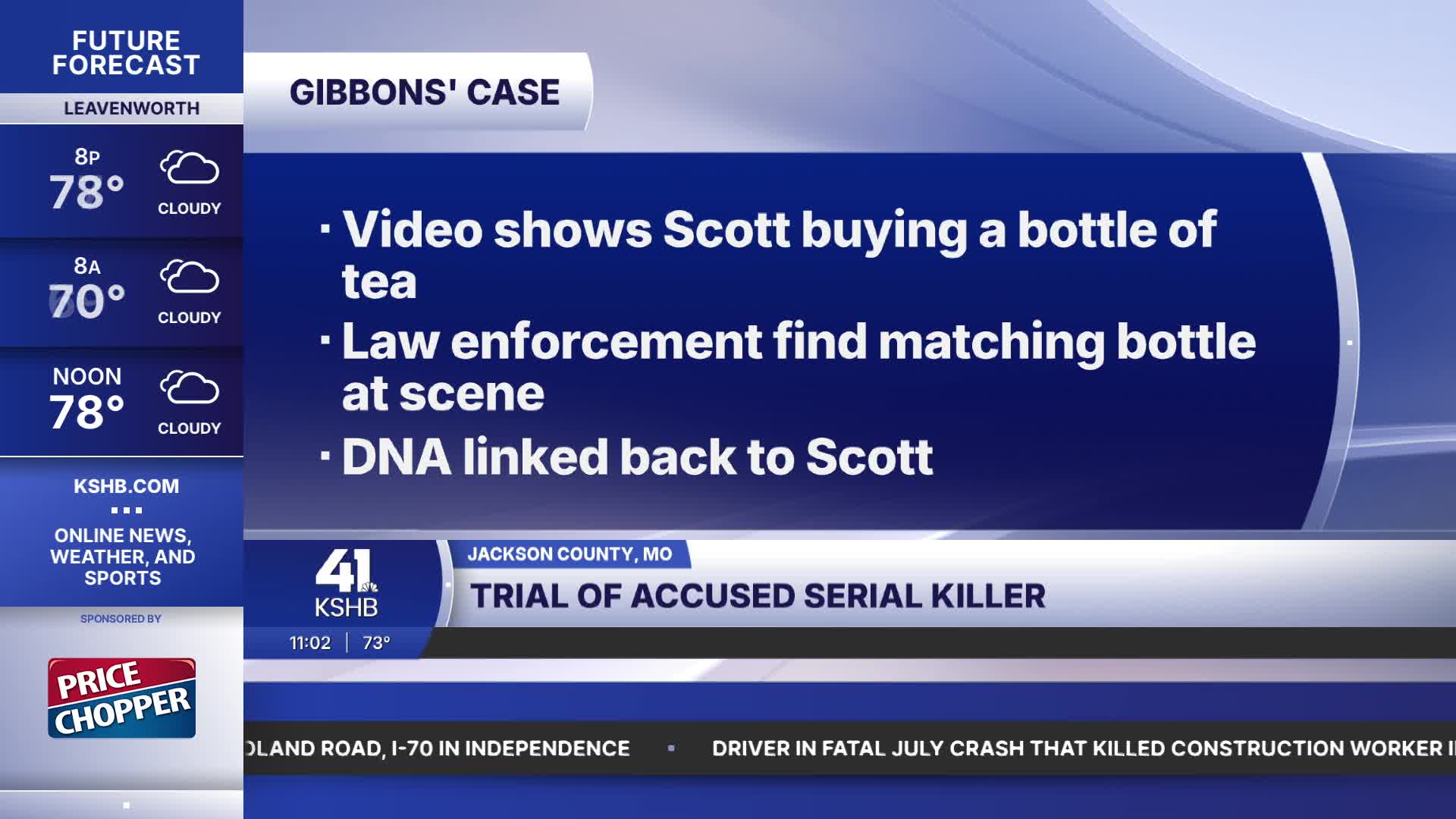
Detectives reported canvassing the area and obtaining the aforementioned surveillance video. They also discovered video from earlier in the morning at a Kansas City gas station along Troost Avenue, where Scott can be seen smoking outside before entering the gas station and purchasing a bottle of Brisk Iced Tea.
In the subsequent video showing both Gibbons and Scott walking away from the bus, Scott appears to still have the bottle in his hand.
After recovering the gas station footage, detectives and crime scene investigators returned to the scene two days later and found a bottle of Brisk Iced Tea, which appeared to have been thrown over a fence along the same stretch of road.
Charging documents showed the bottle tested positive for Scott's DNA. Scott was arrested and later charged.
During an interrogation, Scott admitted to killing Gibbons, but he claimed it was a mistake. He also admitted to killing Palmer, the first victim.
No motive has ever been alleged, beyond repeated statements from Scott about being upset over his brother's murder in 2015.
At this point in the trial, the state has outlined all six deaths in chronological order, and appears to be highlighting what prosecutors previously described as a "distinct pattern" in opening statements.
The state is expected to expand upon earlier claims that Scott "fraudulently reported guns stolen" four times, often shortly before or after the killings occurred. Prosecutors said one of those guns was recovered from Scott's home after his arrest.
While the defense has yet to present its case, attorneys for Scott suggested in opening statements that because three of those guns remain missing, the state can't conclusively link some of those crimes to Scott.
His attorneys also stated the confession in the interrogation was not a "true reflection," noting the detective "pressed (him) pretty hard."
The defense claimed "none of these have rational deliberation, so there's no first-degree murder."
This case has been delayed for almost a decade due to a change in the judge and the defense attorney, and issues with Scott fluctuating in and out of mental competency.
Scott is diagnosed with schizophrenia, but over the years, there have been concerns about him taking his medication while in the Jackson County Jail. Individuals can't be forced to take medications while in jail, unlike a patient in the Missouri Department of Mental Health.
As a result of not taking his medication, Scott has had periods where he was determined to not be mentally competent to stand trial, and he was sent to DMH, where he was placed back on medication and restored to competency.
Due to delays in the system, DMH has told KSHB 41 News there are extended wait times to be evaluated for mental competency, along with even longer wait times to get in for treatment.
Anchor and I-Team reporter Caitlin Knute has been following this case for years, and she has been in court each day.
KSHB 41's previous trial coverage
Day 1: Jury hears opening statements in trial of accused serial killer Fredrick Scott
Day 2: Closer look at murders, evidence in case
Day 3: Testimony on death of Michael Darby
—