

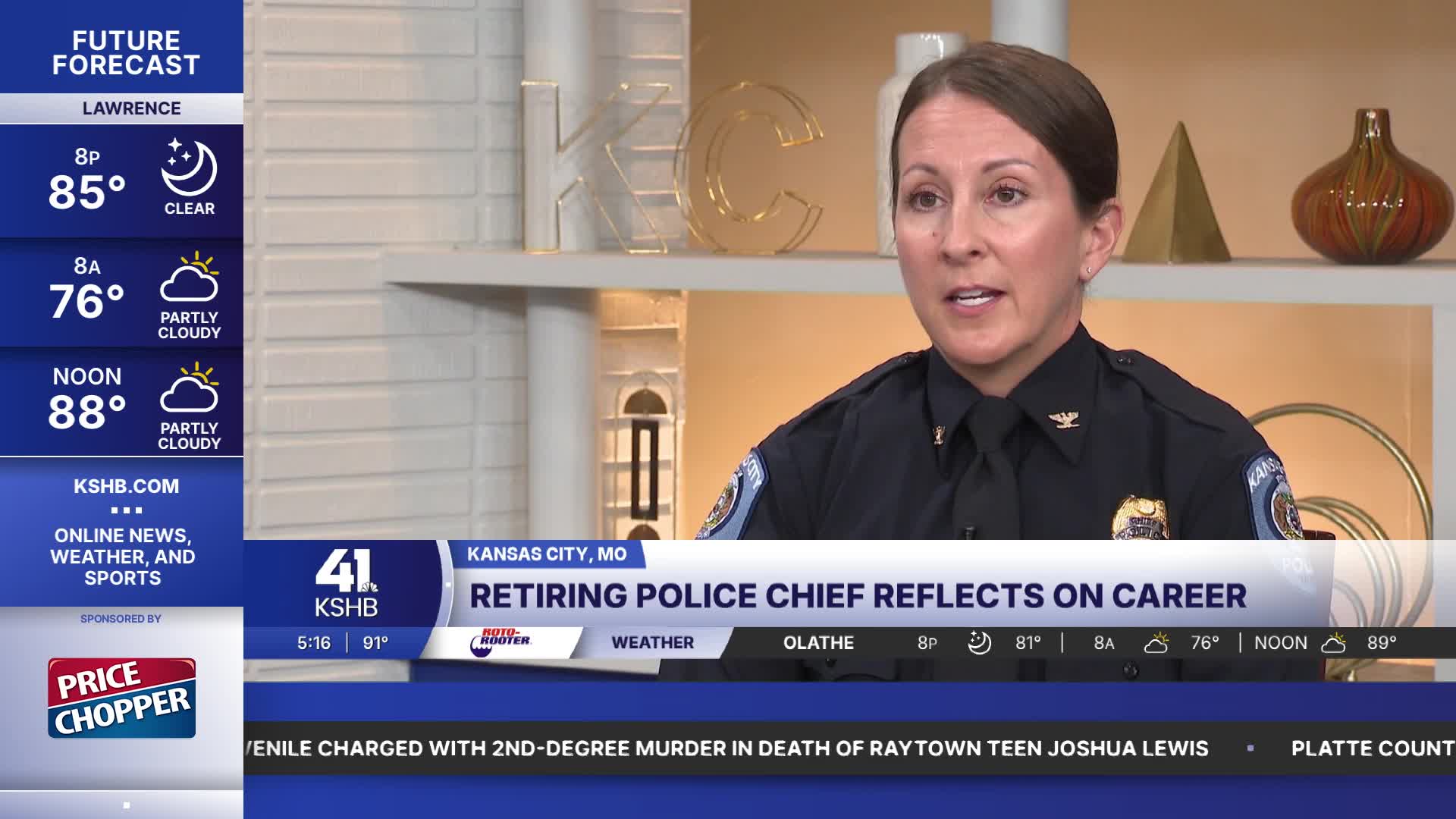


KANSAS CITY, Mo. — KCPD Chief Stacey Graves spoke with KSHB 41 reporter Alyssa Jackson in her first one-on-one interview since her retirement announcement. Share your story idea with Alyssa.
—
Kansas City, Missouri, Police Chief Stacey Graves announced her retirement this summer after 29 years in law enforcement.
"It's my time," she said in a June press conference.
Her career started as a records clerk in 1997.
"This is gonna date myself, but I found an ad in the newspaper for a police clerk," Graves said in her first one-on-one interview since announcing her retirement. She spoke with KSHB 41 News' Alyssa Jackson.
Graves became a police officer, worked her way to Major, and eventually became the department’s first permanent female police chief.
I asked her if she felt any pressure from that distinction.
"I didn’t allow any pressure as far as my gender. I say that because I was the most qualified candidate for the position," Graves said. "I acknowledge the honor of being the first female police chief in 148 years, but I led as a person trying to do the best that I can."
In her career, Graves advocated for focused deterrence, a program that identifies individuals likely to commit a crime.
Lately, homicides and non-fatal shootings have been at a low.
I asked her the key to keeping homicides and non-fatal shootings down for the long-term.
"Each one of those numbers is a person," she told me. "Each one of those numbers, whether it’s a homicide, they have a family...non-fatal doesn’t mean it's not life-altering."
"We can reduce violence," she continued. "We can sustain it — this will be the third year in a row."
The focus of our interview turned to a more recent uncomfortable conversation about KCPD lawsuit settlements and the impact they have on the department's budget.
"Unfortunately, we live in a litigious society. A lot of major metropolitan police departments in the United States, unfortunately, experience a lot of lawsuits," Graves told me. "Maybe we didn’t do something right or did a lot of things right and there's one thing that calls everything into question. When we're faced with lawsuits such as that, it's better to settle some of those lawsuits than take all of them to trial. Sometimes it's more costly to the taxpayer."
I wanted to know why it took KCPD so long to let go of former KCPD officer Blayne Newton, an officer who contributed to those legal bills.
Newton resigned from the department in February with a $50,000 settlement.
"We are bound by laws, policies and procedures. In some of those cases where you have situations where you have an officer, for whatever reason, involved in some type of lawsuit," Graves told me. "The public doesn’t see what’s going on behind the scenes, our personnel records are closed under Missouri sunshine as they should be. That’s when police rely on the trust in our community to know whether it be the chief or police or organization as a whole takes these situations seriously and they’re dealt with properly."
Graves told me that in an effort to prevent further lawsuits, the department has professionalized the human resources division, started duty-to-intervene training, de-escalation training and constitutional policing.
Following the World Cup, Graves said she told herself she would decide whether it was time for retirement.
I wanted to know if there was anything she didn't get around to doing or accomplishing before she announced her retirement.
"That’s the chase, and I call that the chase because that is what can interfere with your decision as chief of police to retire or not," Graves said. "There's always a next project. You can always chase that."
Graves remembers the fresh college graduate who was looking at a newspaper advertisement for a police clerk position for the Kansas City, Missouri, Police Department.
"What do you think she’d think of you today?" I asked her.
"I think she’d be proud. I think she’d be proud," the chief said.
As for what's next, Graves doesn't have immediate plans to work anywhere else during retirement. She is still calling Kansas City home.
Her advice to the next KCPD Chief of Police?
"When I came in, I said I wanted to start by listening," she said. "I would give that advice."
—

![020626_KSHB_Image_NXA_Web_Standard Cube[88].jpg](https://ewscripps.brightspotcdn.com/dims4/default/0ead409/2147483647/strip/true/crop/300x225+0+13/resize/960x720!/format/webp/quality/90/?url=http%3A%2F%2Fewscripps-brightspot.s3.amazonaws.com%2F8f%2F6c%2Ffad8bd2346c5a4d4ead793017d4a%2F020626-kshb-image-nxa-web-standard-cube88.jpg)