



KANSAS CITY, Mo. — KSHB 41 News anchor Caitlin Knute is interested in hearing from you. Send her an e-mail.
—
For nine days, I have attended the trial of Fredrick Scott, who is accused of first-degree murder in the deaths of six people between 2016 and 2017. Nearly all the murders were on or near the Indian Creek Trail.
Both the defense and prosecution have rested their cases, so for Day 10, both sides will present their closing arguments. Then, the jurors will get this case.
Wednesday, I learned I missed something at the end of court Tuesday. Sources inside the courtroom told me that after I left to prepare for the 5 p.m. news, the defense made another motion for a mistrial, claiming a juror rode down an elevator with someone possibly connected to one of the victims.
The judge ultimately denied the motion. But as of Wednesday, the gallery has been instructed to wait until all jurors have gone down the elevators before leaving.
Otherwise, Wednesday resumed the interrogation of Scott that took place in August 2017, just a few days after the sixth victim, Steven Gibbons, was killed.
Surveillance video from the area led police to identify Scott as a possible suspect. An officer recognized Scott on the street and collected his discarded cigarette butt as evidence. Police matched that cigarette butt to DNA found at a couple of the murder scenes. That is when police arrested Scott for questioning.
The interrogation lasted approximately 11 hours.
The state is playing that video in its entirety, although prosecutors are speeding through portions where Scott took a break, ate or slept.
I reached out to local attorney Craig Divine, who is not affiliated with the case but is familiar with it, to ask if the state was required to play the entire video to enter it as evidence.
"My guess is that the state had asked the defense about playing a clipped version of the recording, and the defense said no. When you put an interrogation in evidence, you do need to admit the entire recording into the record," Divine said. "But if both sides agree to allow a trimmed-down version to be played for the jury and be the version of the recording that the jury gets, then you can do that. If I had to guess, I would say the defense wants the length of that interrogation to be fully felt by the jury so that the jurors understand just how long a process that was, and how it can wear a person down."
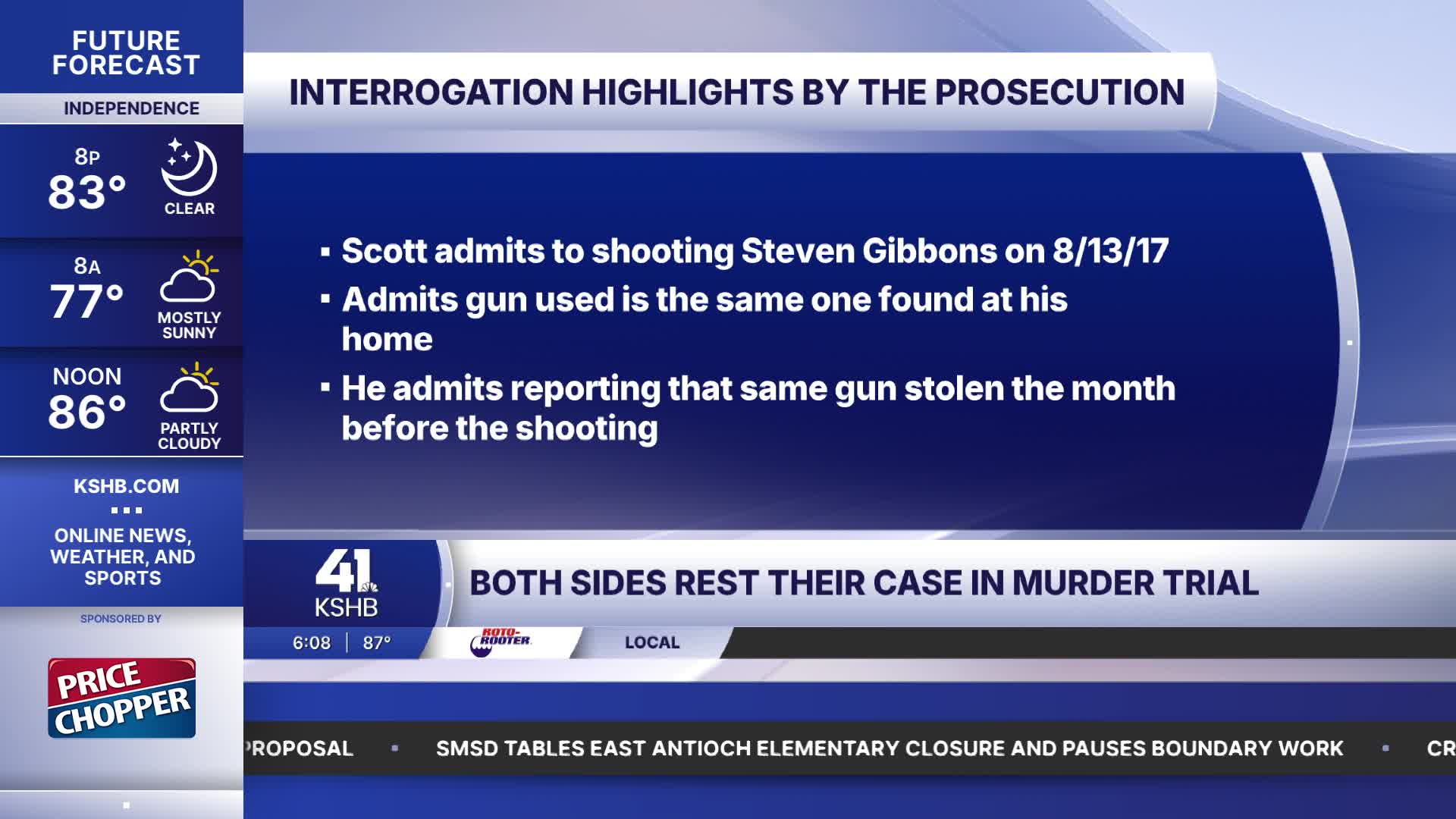
Highlights from the interrogation video shown Wednesday include:
- Scott admitted to shooting Gibbons on Aug. 13, 2017.
- Initially, Scott changed his story several times about his whereabouts on the day Gibbons was murdered. But police had surveillance images of him on the bus with Gibbons, getting off the bus after Gibbons, following him down the street, eventually closing the gap behind him and then running away from the scene.
- He told a detective the shooting was an accident because the gun went off when he was messing with it.
- He also admitted the gun used was the same one found at his home, which he had reported stolen the month before the shooting. Earlier, he claimed he threw the gun over the bridge.
- Scott admitted to shooting John Palmer a year earlier on Aug. 19, 2016. He said he “dragged the body into the high grass.”
- Additionally, he admitted the red shirt found at the scene that had Palmer’s blood on the outside and Scott’s DNA on the inside was his. At first, he claimed, "I've never seen that shirt before."
- Plus, Scott said the gun he used was the same one he had reported stolen two days earlier on Aug. 17, 2016.
- While Scott didn't provide specifics on why he shot the men, he was upset over the murder of his brother.
- Scott denied involvement in the other murders, although he did admit to using the Indian Creek Trail, visiting the apartment complex where David Lenox was killed, and he acknowledged that he was on the Indian Creek Trail on the day at around the same time Mike Darby was killed.
- When detectives started pressing Scott about how many people he killed, he started complaining, saying he didn't "feel right about the interrogation."
Attorney Craig Divine said the length of the interview is no doubt a tactic used by police.
“A lengthy interrogation is a police tactic to mentally and physically exhaust a defendant into talking," Divine said. "If the defense feels like that lengthy interrogation combined with his mental health issues caused him to be confused or to not understand what was going on, then they would be arguing that that created conditions whereby a false confession was elicited. I'm guessing you'll probably see some argument along those lines.”
We will continue to bring you the latest on air and online. A reminder, our request for a camera in the courtroom was denied, and this case was sealed in 2017 by the previous judge.
KSHB 41's previous trial coverage
Day 1: Jury hears opening statements in trial of accused serial killer Fredrick Scott
Day 2: Closer look at murders, evidence in case
Day 3: Testimony on death of Michael Darby
Day 4: Video and iced tea bottle led to alleged Indian Creek Trail serial killer's arrest
Day 5: Judge denies defense's motion for mistrial
Day 6: Pawnshop owner says Scott bought multiple 9mm guns from store
Day 8: 11-hour video of 2017 police interrogation played in court
—
![020626_KSHB_Image_NXA_Web_Standard Cube[88].jpg](https://ewscripps.brightspotcdn.com/dims4/default/0ead409/2147483647/strip/true/crop/300x225+0+13/resize/960x720!/format/webp/quality/90/?url=http%3A%2F%2Fewscripps-brightspot.s3.amazonaws.com%2F8f%2F6c%2Ffad8bd2346c5a4d4ead793017d4a%2F020626-kshb-image-nxa-web-standard-cube88.jpg)