

KANSAS CITY, Mo. — KSHB 41 News anchor Caitlin Knute is interested in hearing from you. Send her an e-mail.
—
After weeks of trial and 10 years since the death of the first victim, Fredrick Scott has been found guilty of four murders.
Scott was charged with six counts of first-degree murder and six counts of armed criminal action in the deaths of six people — John Palmer, Michael Darby, Karen Harmeyer, Steven Gibbons, David Lenox and Timothy Rice — from 2016 to 2017. Four of the six victims were killed on or near the Indian Creek Trail.
The 12-person jury, made up of seven women and five men, found Scott guilty of four counts of first-degree murder and four counts of armed criminal action; he was found not guilty of two counts of first-degree murder and two counts of armed criminal action. He had pleaded not guilty.
Scott was found guilty in the deaths of Palmer, Darby, Harmeyer and Gibbons. He was found not guilty in the deaths of Lenox and Rice.
Following hours of deliberation, the jury announced Tuesday afternoon that it recommends Scott be sentenced to life in prison without the possibility of probation or parole for each of the first-degree murder convictions, as well as the maximum 15 years for each armed criminal action conviction. The formal sentencing hearing will be held Nov. 23.
Many family members attended the trial daily to honor their loved ones, including Brian Darby, son of Mike Darby. Brian described the day as "bittersweet" and said the past decade has been emotionally exhausting.
"Every family has its own kind of grief, and this is ours," he said. "It's been a little different, but yes, it feels like this chapter should finally be wrapping up."
Brian's sister provided a victim statement ahead of sentencing.
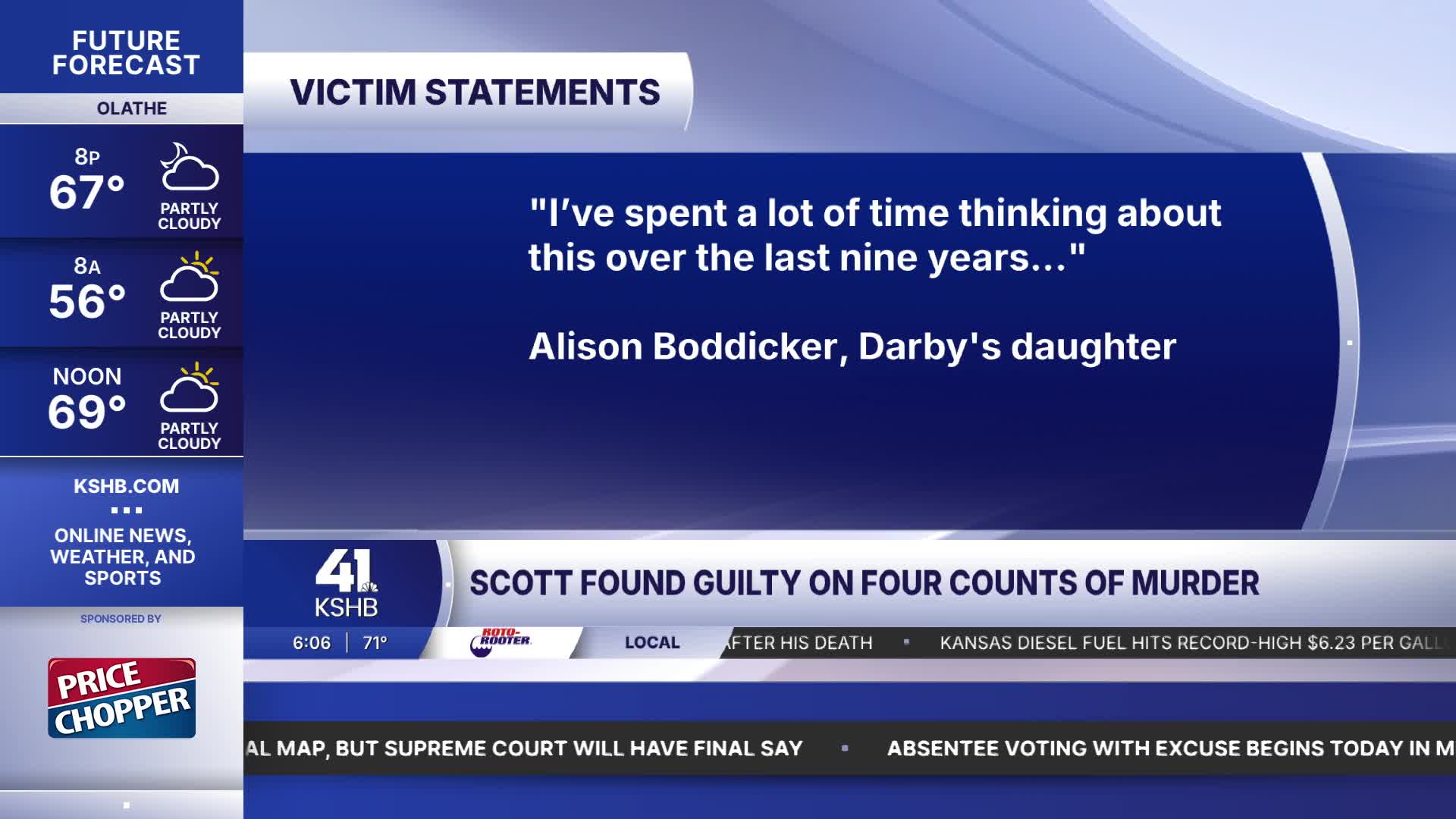
"I've spent a lot of time thinking about this over the last nine years..." said Alison Boddicker, daughter of Mike Darby. "It's the first thing I think about every morning when I wake up and the last thing I think about before I go to bed, and I know my siblings feel the same way."
Kathy Palmer, widow of John Palmer, provided a victim statement, too.
"It felt like I was torn in half," she said. "It was like someone cut me open and ripped my brain out. I couldn't think right."
While Jackson County Prosecutor Melesa Johnson is pleased Scott was convicted of four murders, she said she's heartbroken for the families of Lenox and Rice.
"It's been a long time coming, and while justice can sometimes be delayed, I'm very grateful — for the majority of the families — that today justice was not denied," she said.
Johnson said she is proud of the trial team, who worked through "nights, weekends and setback-after-setback, never wavering because they believed John, David, Timothy, Mike, Karen and Steven were worth fighting for no matter how long it took." She also said she wants the Rice and Lenox families to know the trial team fought for them.
"I want them to know that we fought for them, that this trial team fought for them. And while we are certainly not pleased with the outcome either, this is the process," Johnson said. "We believe in the judicial system, even when it does not weigh in our favor. And so again, my heart and condolences continue to be with them. It is unfortunate that their chapter is not closed. But hopefully the camaraderie that these families have created over nearly a decade — they have a community to lean on and to get through this very difficult time."
Tuesday's verdict concludes one of the longest-running criminal cases in the county's history, which included more than 70 witnesses and hundreds of pieces of evidence across three weeks of trial.
KSHB 41’s Caitlin Knute attended court each day throughout the trial.
Some moments that stood out to her came from the 11-hour police interrogation of Scott. He ultimately confessed to killing John Palmer and dragging his body off the trail; he admitted he lied when he reported the gun he used stolen, just two days before the shooting; and he acknowledged a red shirt found at the scene with his DNA on the inside and Palmer’s blood on the outside was his.
Scott also admitted to shooting Gibbons, confessing the gun used was the same one recovered from his home, even though he reported that same gun stolen the month before the shooting.
A forensics expert for the state testified that bullet fragments and shell casings recovered at the murder scenes of Gibbons and Harmeyer matched the gun that was recovered.
Scott never provided a reason for the killings in the interrogation, only saying he was upset over the murder of his brother.
While he denied involvement in the other murders, Scott did admit to using the Indian Creek Trail, admitted to visiting the apartment complex where Lenox was killed, and he acknowledged that he was on the trail on the same day and around the same time Darby was killed.
Interestingly enough, the defense did not dispute that Scott killed Palmer and Gibbons. Rather, they suggested there was no premeditation or cool, deliberate planning. They said he was a confused, mentally ill young man who was experiencing turmoil at the time.
The state countered that all six deaths followed a clear pattern and occurred in areas known to Scott.
For years, Scott’s mental illness factored into the delay of the case as he fluctuated in and out of mental competency.
KSHB 41's previous trial coverage
Day 1: Jury hears opening statements in trial of accused serial killer Fredrick Scott
Day 2: Closer look at murders, evidence in case
Day 3: Testimony on death of Michael Darby
Day 4: Video and iced tea bottle led to alleged Indian Creek Trail serial killer's arrest
Day 5: Judge denies defense's motion for mistrial
Day 6: Pawnshop owner says Scott bought multiple 9mm guns from store
Day 8: 11-hour video of 2017 police interrogation played in court
Day 9: Interrogation continues
Day 10: Jury begins deliberations; jurors ask judge to go home after roughly 5 hours
—